
 PRESS RELEASE • FOR IMMEDIATE RELEASE
Argos identifies explosives, homemade explosives and other chemical threats without contact at up to 15 meters with results in seconds.
TAMPA BAY, Florida, USA — October 16, 2026— Alakai Defense Systems, Inc., a veteran-owned technology company based in the Tampa Bay region of Florida, is introducing Argos, its handheld deep ultraviolet (UV) Raman standoff chemical detector, to explosive ordnance disposal (EOD), bomb technicians, counter-IED and security teams worldwide.
Argos identifies explosives, homemade explosives (HME), explosive precursor chemicals, chemical warfare agents (CWA), toxic industrial chemicals (TICs), toxic industrial materials (TIMs), and other chemical threats/hazardous materials without contact, at standoff distances of up to 15 meters, with results between 4 and 15 seconds. Operation is simple – the operator aims Argos, fires and receives a color-coded result – red for a threat, green for a non-threat – with supporting full chemical identification information, hazard data from the GHS database, photographic evidence of what was analyzed, GPS coordinates, and the spectrum of the material.
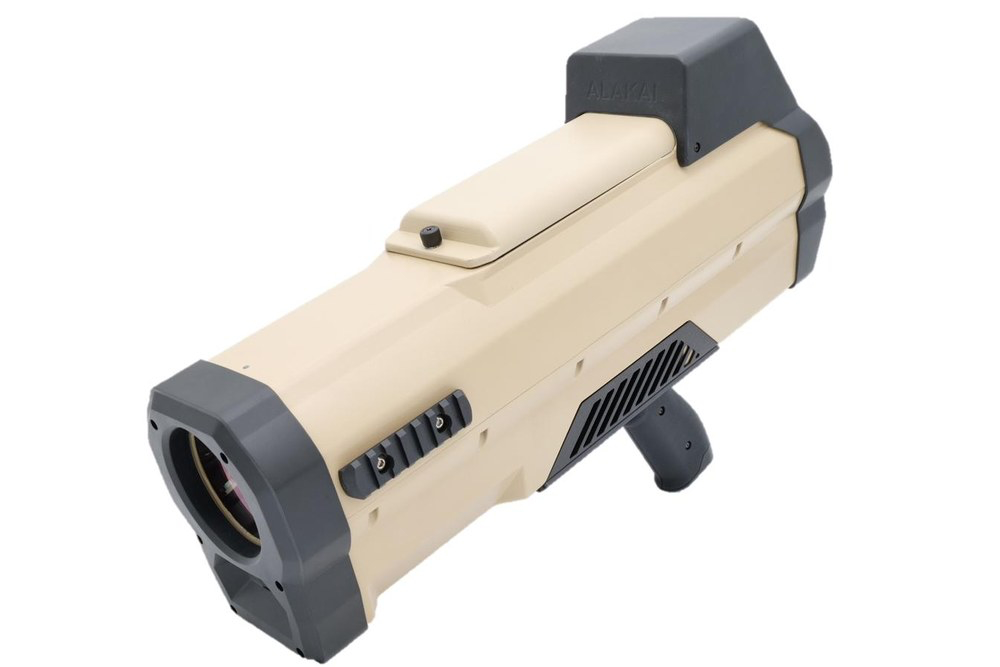
Argos handheld deep UV Raman standoff chemical detector
Core C-IED / EOD Capabilities
- Standoff identification: 0.7 to 15 meters from the target.
- Fast results: 4 to 15 seconds typical integration time per shot.
- Explosives and HME library: Including explosives, HME, CWAs, TICs/TIMs and hazardous materials, identified by an on-board AI/machine-learning trained algorithm.
- Trace to bulk: Detects bulk samples, residues and trace samples.
- Works in daylight: The 261 nm laser operates outdoors in direct sunlight, conditions that can interfere with traditional infrared Raman systems.
- Evidence and reporting: A photograph is captured with every shot, and one-page PDF reports can be exported for documentation and forensic exploitation.
- Hot-zone ready: Designed for typical hot-zone tasks in Level A PPE, with remote operation from the cold zone via the included mobile device.
- Rugged: MIL-STD-810H shock and vibration tested.
Global Footprint & Operational Support
- Export classification: Argos is not ITAR-controlled; it is classified under ECCN 1A004.D. Licensing requirements depend on destination and end user.
- Local support: International customers are supported through Alakai’s local channel partners, with reachback support from Alakai.
- Continuous improvement: Standard software updates are released twice a year, and Alakai works with customers to expand the chemical library with region-specific data.
See Argos in Action
-
- Trace explosive residue detection (3 trace explosives identified at 5 meters away in 20 seconds)
-
- Liquid trace detection (3 liquid trace samples representing explosives, CWAs, and TICs at 5 meters away in 20 seconds)
-
- Speed of analysis in bright daylight (10 samples in bright daylight in 2 minutes)
About Alakai Defense Systems, Inc.
Alakai Defense Systems is a veteran-owned technology company based in the Tampa Bay region of Florida within the United States. For more than 20 years, Alakai has specialized in deep ultraviolet (UV) laser and electro-optical sensors for standoff detection of chemical threats in defense and security applications. Alakai designs and manufactures its systems in-house in Florida.
Visit alakaidefense.com or contact us at [email protected] | Tel: +1 727 541 1600
Sign up for the Counter-IED Report Newsletters
The latest news and insights delivered right to your inbox
Related:
- Competition Update: Innovative Research Call 2020 for Explosives and Weapons Detection
September 21, 2020
This Defence and Security Accelerator (DASA) competition is seeking innovative proposals to develop and improve explosives and weapons detection capability. The Innovative Research Call (IRC) 2020 for Explosives and Weapons Detection is funded and supported by the Home Office, Department for Transport (DfT), Centre for the Protection of National Infrastructure (CPNI), Defence Science and Technology Laboratory ...
- Miami International Airport: Fly through security with new screening technology
September 21, 2020
Security screening at Miami International Airport in the post-COVID-19 era just got easier, thanks to the installation of seven state-of-the-art computed tomography (CT) scanners at six Transportation Security Administration (TSA) checkpoints. Passengers traveling through a lane with a CT scanner will now be permitted to leave laptops and other electronic devices in their carry-on bags. The ...
- Gatwick Airport is sharing snaps of its best airport dogs and they’re adorable
September 18, 2020
Gatwick Airport is offering up a break from the doom and gloom with some adorable photos of the dogs which work at the airport. The company has been sharing snaps of some of the dogs it employs, and sharing some sweet tidbits about them including their professional and personal lives. The light-hearted project first started in July, ...
- From identification to a chemical fingerprint for explosives in forensic research
August 31, 2020
The police frequently encounter explosives in their forensic investigations related to criminal and terrorist activities. Chemical analysis of explosives can yield valuable tactical information for police and counter-terrorist units. Within the compass of her doctoral research, Karlijn Bezemer has developed a new generation of tools which can be used to not only identify signature properties ...
- DHS Awards $1 Million to Support Machine Learning Development for Airport Security
August 28, 2020
FOR IMMEDIATE RELEASE S&T Public Affairs, 202-254-2385 Washington, D.C. – With a growing need to improve the security, efficiency and accuracy of passenger and baggage screening, the Department of Homeland Security (DHS) Small Business Innovation Research (SBIR) Program is working with a small business to advance explosive detection equipment. Synthetik Applied Technologies was awarded funding to develop machine learning training ...
- Nanotechnology for explosives trace detection
August 26, 2020
Whether it’s an airport screening station or in-the-field terrorism investigations, trace detection of explosives – which are chemical compounds – generally involves the collection of vapor or particulate samples from these chemicals and analyzing them using a sensitive sensor system. Explosive trace detection (ETD) is a challenging task. As the name suggests, ‘trace’ refers to quantities ...
- DHS S&T Transitions Next-Generation Explosives Trace Detection Technology to DARPA
August 25, 2020
Explosive materials pose a threat whether they are used by domestic bad actors or in a theater of war and staying ahead of our adversaries is a job that the Departments of Homeland Security and Defense share. Our research and development work is no different. Most recently, the Department of Homeland Security (DHS) Science and Technology ...
- Bomb-sniffing ‘cyborg locusts’ advance under Navy-funded research
August 19, 2020
Navy-funded researchers have discovered that a locust’s sensitive “horns” can distinguish between the scents of TNT and other explosives — a development that one day could herald the deployment of bomb-sniffing, electronically augmented bug swarms. The research by a team from Washington University in St. Louis, published this month in the science journal “Biosensors and Biolectronics: ...
- New landmine detection method to reduce false alarm rates
August 18, 2020
RESEARCH TRIANGLE PARK, N.C. — Landmines pose a serious threat in conflict areas, yet modern detection systems struggle to discriminate between explosives and clutter. A project funded by the Army developed a new method for landmine identification that will greatly reduce false alarm rates. Fewer false alarms will significantly reduce the cost of humanitarian landmine clearance ...
- NATO boosts scientific cooperation with Ukraine
August 7, 2020
The NATO Science for Peace and Security (SPS) Programme provides the Ukrainian scientific community with a platform to work side-by-side with NATO Allies and partner countries on security-related issues. Ukraine is currently leading 27 ongoing activities, one of which is a key flagship project in the field of counter-terrorism called DEXTER (Detection of Explosives and Firearms ...
- UK: £2.8m innovation funding to boost detection of explosives, weapons and illicit drugs
August 5, 2020
DASA launches competition to find and develop new technology to screen people, possessions, goods, vehicles, areas and buildings The Defence and Security Accelerator (DASA) is launching a £2.8 million competition to find state of the art and technological solutions for the improved detection of explosives, weapons and illicit drugs. The Innovative Research Call (IRC) 2020 for Explosives ...
- Qatar: Hamad International Airport’s new technology allows electronic items to stay in baggage during screening
July 27, 2020
Hamad International Airport (HIA) will install new airport security screening technology that allows transfer passengers to keep electronic devices such as laptops, tablets, and digital cameras in their hand luggage while going through security checkpoints. The airport says the new technology also allows security personnel to “easily detect explosive materials held in complex items and structures”. Qatar’s ...
- The Role of Nanotechnology in a Forensic Investigation
July 7, 2020
It is evident that the application of nanoscience in a forensic investigation has helped criminologists to solve crime mysteries in less time and with greater efficiency. The rapid advancements in forensic science come with technological improvements in nanotechnology. This article highlights some of the major achievements in forensic science based on nanotechnology. Identification of Fingerprints Fingerprints have ...
- UK: Southend Airport to stop removal of liquids and laptops from hand luggage
June 29, 2020
Southend Airport is set to become the country’s first airport to stop making passengers remove liquids and laptops thanks to new X-Ray machine technology. The growing airport will next month abandon the practice of asking passengers to remove liquids and laptops from hand luggage as they go through scanners. Bosses say it will help to stop people ...
- Video: How Do You Deliver a K-9 Team Onto a Ship?
June 28, 2020
What do the Super Bowl, presidential inaugurations and maritime mass transit have in common? Coast Guard K-9 units on duty to serve and protect. While the Coast Guard’s K-9 units are stationed at major ports with a primary focus on maritime mass transit, their expertise in explosives detection makes them uniquely suited to provide security for ...