
 PRESS RELEASE • FOR IMMEDIATE RELEASE
Argos identifies explosives, homemade explosives and other chemical threats without contact at up to 15 meters with results in seconds.
TAMPA BAY, Florida, USA — October 16, 2026— Alakai Defense Systems, Inc., a veteran-owned technology company based in the Tampa Bay region of Florida, is introducing Argos, its handheld deep ultraviolet (UV) Raman standoff chemical detector, to explosive ordnance disposal (EOD), bomb technicians, counter-IED and security teams worldwide.
Argos identifies explosives, homemade explosives (HME), explosive precursor chemicals, chemical warfare agents (CWA), toxic industrial chemicals (TICs), toxic industrial materials (TIMs), and other chemical threats/hazardous materials without contact, at standoff distances of up to 15 meters, with results between 4 and 15 seconds. Operation is simple – the operator aims Argos, fires and receives a color-coded result – red for a threat, green for a non-threat – with supporting full chemical identification information, hazard data from the GHS database, photographic evidence of what was analyzed, GPS coordinates, and the spectrum of the material.
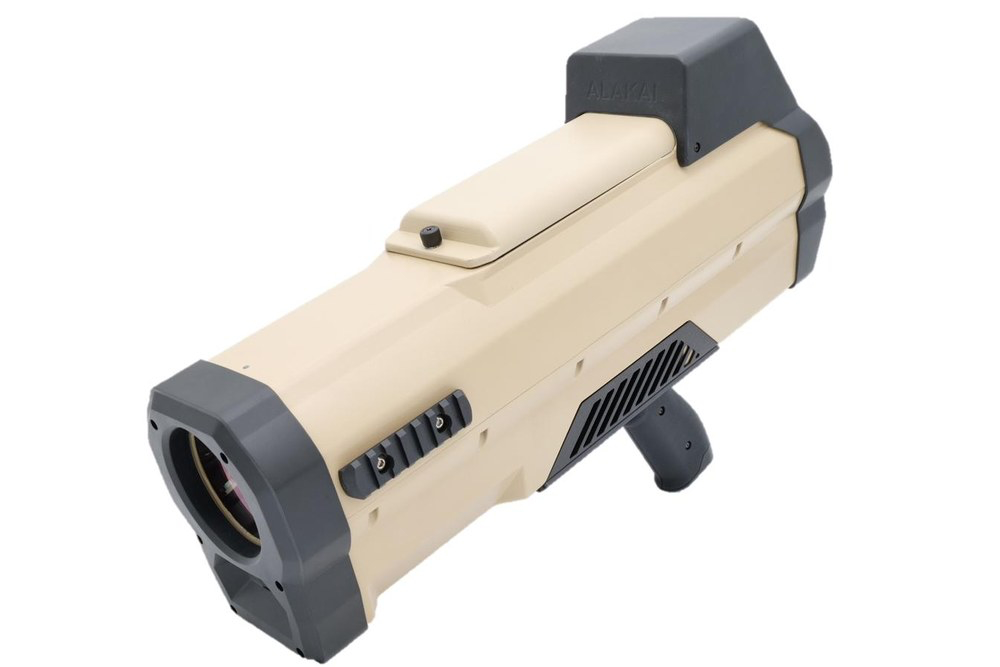
Argos handheld deep UV Raman standoff chemical detector
Core C-IED / EOD Capabilities
- Standoff identification: 7 to 15 meters from the target.
- Fast results: 4 to 15 seconds typical integration time per shot.
- Explosives and HME library: Including explosives, HME, CWAs, TICs/TIMs and hazardous materials, identified by an on-board AI/machine-learning trained algorithm.
- Trace to bulk: Detects bulk samples, residues and trace samples.
- Works in daylight: The 261 nm laser operates outdoors in direct sunlight, conditions that can interfere with traditional infrared Raman systems.
- Evidence and reporting: A photograph is captured with every shot, and one-page PDF reports can be exported for documentation and forensic exploitation.
- Hot-zone ready: Designed for typical hot-zone tasks in Level A PPE, with remote operation from the cold zone via the included mobile device.
- Rugged: MIL-STD-810H shock and vibration tested.
Global Footprint & Operational Support
- Export classification: Argos is not ITAR-controlled; it is classified under ECCN 1A004.D. Licensing requirements depend on destination and end user.
- Local support: International customers are supported through Alakai’s local channel partners, with reachback support from Alakai.
- Continuous improvement: Standard software updates are released twice a year, and Alakai works with customers to expand the chemical library with region-specific data.
See Argos in Action
-
- Trace explosive residue detection (3 trace explosives identified at 5 meters away in 20 seconds)
-
- Liquid trace detection (3 liquid trace samples representing explosives, CWAs, and TICs at 5 meters away in 20 seconds)
-
- Speed of analysis in bright daylight (10 samples in bright daylight in 2 minutes)
About Alakai Defense Systems, Inc.
Alakai Defense Systems is a veteran-owned technology company based in the Tampa Bay region of Florida within the United States. For more than 20 years, Alakai has specialized in deep ultraviolet (UV) laser and electro-optical sensors for standoff detection of chemical threats in defense and security applications. Alakai designs and manufactures its systems in-house in Florida.
Visit alakaidefense.com or contact us at [email protected] | Tel: +1 727 541 1600
Sign up for the Counter-IED Report Newsletters
The latest news and insights delivered right to your inbox
Related:
- Alabama Hosting Law Enforcement, Dog Teams For Explosives Training
August 4, 2022
Fifteen dog teams from across Alabama and Mississippi are in Tuscaloosa for a three-day training offered by the U.S. Department of Homeland Security. The University of Alabama is hosting the Department of Homeland Security’s Regional Explosives Detection Dog Initiative. REDDI is a program designed to enhance the abilities of police departments to detect bombs and improvised ...
- Dogs might be able to ‘see’ with their noses, a new study suggests
July 27, 2022
Dogs might be using their highly-sensitive noses to ‘see’ as well as to smell, a new study suggests. A team of vets, including Dr Philippa Johnson from Cornell University in New York, discovered that vision and smell are actually connected in the brains of dogs – something not yet found in any other species. The team conducted ...
- Kenya banks on camels to stop IED killings on Somalia border
July 20, 2022
For the past decade, the menace of attacks using Improvised Explosive Devices in some parts of the country has been devastating. Official counts show Kenya has lost more than 100 security officials and two times more civilians to IEDs set on the roads. And it is not clear how long it would take to address the menace ...
- Minnesota: K-9 teams gather in Arden Hills to train on explosive-detection skills
July 13, 2022
Dozens of dogs across Minnesota, Wisconsin and Canada came together on Wednesday to sniff out trouble. More than 30 K-9 teams came to the Arden Hills Army Training Center to earn their National Odor Recognition Testing (NORT) certification. One of those dogs was Eddie, and his partner and handler, Officer Brady Harrison with St. Paul Police Department ...
- Latvia: Riga Airport to Purchase New Explosives Detection System for Checking Hand Luggage
July 6, 2022
Riga Airport of Latvia will purchase a new explosives detection system to control passengers’ hand luggage by using financial savings from the European Cohesion Fund. Through a statement issued on June 30, the Ministry of Transport of Latvia emphasized that the purchase of the system is foreseen by the changes in the contract signed with the ...
- Yemen: YEMAC Calls on UN to Provide Detectors for Mines to Secure Lives of Civilians
July 2, 2022
The Sana’a-based Yemen Executive Mine Actions Center (YEMAC) called on the United Nations and humanitarian organizations to make efforts to urgently provide detectors to clear areas contaminated with mines, cluster bombs and remnants of war. In a statement issued Saturday, the center urged the United Nations and humanitarian organizations to continue supporting the center’s activities to ...
- Michigan: Grand Rapids police dog who did bomb sweeps for rock stars, presidential candidates retires
June 1, 2022
The Grand Rapids police dog who did bomb sweeps for rock stars and presidential candidates has retired. The K-9 dog, Atos, who served with the Grand Rapids Police Department for eight years, retired last week, Grand Rapids police officials announced Wednesday. During his tenure, Atos and his partner, Grand Rapids police Sgt. Jeff Dionne, performed about 200 ...
- Michigan: Meet Hans and Greta, the S.S. Badger’s new explosive detection K9s
May 19, 2022
They’re sweet, friendly, a little bit “ball crazy” – and trained to detect explosives. Hans and Greta are the newest additions to the K9 program for the S.S. Badger car ferry. The pups had their first workday last week when the ferry made its first trip of the year across Lake Michigan. The dogs spent about two ...
- MRAPs with lasers and robotic arms will help the Air Force handle bombs on the flight line
April 7, 2022
An unexploded bomb is a terrible threat, and the Air Force is investing in armored vehicles with powerful lasers and robot arms to safely clear them off runways. In February, the service branch announced that in the fall of 2022 it will start fielding these new bomb disposal vehicles. These machines, and the people inside ...
- TSA Checkpoints Begin Using 3D Checkpoint Scanners to Improve Explosives Detection
April 5, 2022
On April 1, the Transportation Security Administration (TSA) announced that it has installed computed tomography (CT) checkpoint scanners that provide 3D imaging at TSA checkpoints at Frederick Douglass Grater Rochester International Airport (ROC), Rochester, New York. Six CT X-ray units are installed at one checkpoint at the airport and are expected to provide critical explosives detection ...
- How TSA bomb-sniffing dogs are trained
March 29, 2022
The Transportation Security Administration – or TSA – employs more than 1,000 explosives detection canine teams at any given time. But before they’re deployed to one of the many mass-transit sites across the United States, they must graduate from the TSA National Explosives Detection Canine Program. Insider spent a day with the program at the ...
- Meet Patron: Brave Pooch Who Cleared Almost 90 Bombs in Ukraine During Russian Attack
March 21, 2022
Patron, a 2-year-old military dog, is credited with clearing almost 90 explosive devices on Ukrainian soil since Russia invaded, saving countless lives and preventing further bloodshed. Footage of the dog’s brave actions was shared by the State Emergency Service (SES) of Ukraine, the country’s civil defense and rescue agency, on March 19. “News from Patron! Our militant ...
- India: IISc-Bangalore develops paper sensor to detect hydrogen peroxide
March 10, 2022
Researchers from the Department of Organic Chemistry at the IISc have developed a paper-based sensor for detecting tiny volumes of hydrogen peroxide, a chemical used widely in household and healthcare products like hand sanitiser as a disinfectant, in rocket fuel as a propellant, in biological cells, and also as a starting material in peroxide-based explosives. The ...
- China: Police canine Shengmi goes into retirement at age 11
February 24, 2022
Shengmi, an 11-year-old male Labrador who has been a superstar of the canine squad of Shanghai Metro police, has retired. Shanghai Daily visited him at the police canine base in Minhang District on Thursday and talked to his former trainer and lifelong friend, police officer Lu Jie. With dolls and stickers made after him, Shengmi is no ...
- DHS S&T Posts 17 R&D Needs in Annual Long Range Broad Agency Announcement
February 9, 2022
WASHINGTON – The Department of Homeland Security (DHS) Science and Technology Directorate (S&T) posted the annual release of the Long Range Broad Agency Announcement (LRBAA), an open invitation to the scientific and technical communities to propose novel ideas that address DHS Components’ highest priority operational needs. The 2021 announcement includes 17 research and development topics, ...