
 PRESS RELEASE • FOR IMMEDIATE RELEASE
Argos identifies explosives, homemade explosives and other chemical threats without contact at up to 15 meters with results in seconds.
TAMPA BAY, Florida, USA — October 16, 2026— Alakai Defense Systems, Inc., a veteran-owned technology company based in the Tampa Bay region of Florida, is introducing Argos, its handheld deep ultraviolet (UV) Raman standoff chemical detector, to explosive ordnance disposal (EOD), bomb technicians, counter-IED and security teams worldwide.
Argos identifies explosives, homemade explosives (HME), explosive precursor chemicals, chemical warfare agents (CWA), toxic industrial chemicals (TICs), toxic industrial materials (TIMs), and other chemical threats/hazardous materials without contact, at standoff distances of up to 15 meters, with results between 4 and 15 seconds. Operation is simple – the operator aims Argos, fires and receives a color-coded result – red for a threat, green for a non-threat – with supporting full chemical identification information, hazard data from the GHS database, photographic evidence of what was analyzed, GPS coordinates, and the spectrum of the material.
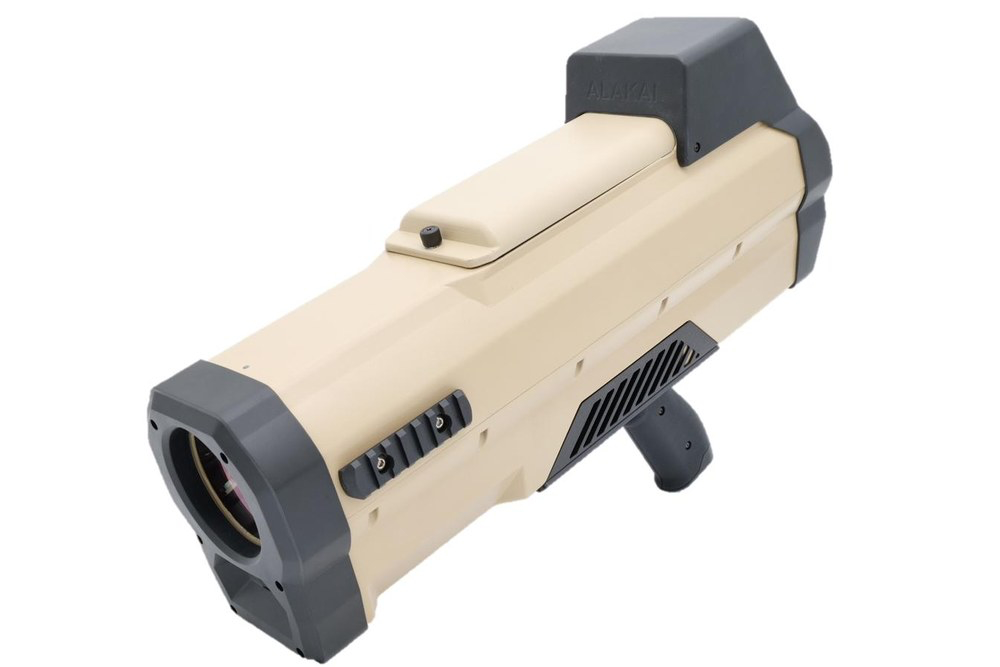
Argos handheld deep UV Raman standoff chemical detector
Core C-IED / EOD Capabilities
- Standoff identification: 0.7 to 15 meters from the target.
- Fast results: 4 to 15 seconds typical integration time per shot.
- Explosives and HME library: Including explosives, HME, CWAs, TICs/TIMs and hazardous materials, identified by an on-board AI/machine-learning trained algorithm.
- Trace to bulk: Detects bulk samples, residues and trace samples.
- Works in daylight: The 261 nm laser operates outdoors in direct sunlight, conditions that can interfere with traditional infrared Raman systems.
- Evidence and reporting: A photograph is captured with every shot, and one-page PDF reports can be exported for documentation and forensic exploitation.
- Hot-zone ready: Designed for typical hot-zone tasks in Level A PPE, with remote operation from the cold zone via the included mobile device.
- Rugged: MIL-STD-810H shock and vibration tested.
Global Footprint & Operational Support
- Export classification: Argos is not ITAR-controlled; it is classified under ECCN 1A004.D. Licensing requirements depend on destination and end user.
- Local support: International customers are supported through Alakai’s local channel partners, with reachback support from Alakai.
- Continuous improvement: Standard software updates are released twice a year, and Alakai works with customers to expand the chemical library with region-specific data.
See Argos in Action
-
- Trace explosive residue detection (3 trace explosives identified at 5 meters away in 20 seconds)
-
- Liquid trace detection (3 liquid trace samples representing explosives, CWAs, and TICs at 5 meters away in 20 seconds)
-
- Speed of analysis in bright daylight (10 samples in bright daylight in 2 minutes)
About Alakai Defense Systems, Inc.
Alakai Defense Systems is a veteran-owned technology company based in the Tampa Bay region of Florida within the United States. For more than 20 years, Alakai has specialized in deep ultraviolet (UV) laser and electro-optical sensors for standoff detection of chemical threats in defense and security applications. Alakai designs and manufactures its systems in-house in Florida.
Visit alakaidefense.com or contact us at [email protected] | Tel: +1 727 541 1600
Sign up for the Counter-IED Report Newsletters
The latest news and insights delivered right to your inbox
Related:
- US Army K9 and handler honored for discovering IED cache in Syria
December 28, 2020
An Army canine earned rare military honors this month after discovering a cache of explosives in Syria while deployed as part of the U.S.-led mission to defeat the Islamic State. Fritz, a 4.5-year-old military working dog who joined the kennels at Fort Carson, Colo., in September 2018, was awarded an Army Commendation Medal with “C” device ...
- CMAC and Apopo sign MoU on land mine detection rats
December 14, 2020
The Cambodian Mine Action Centre (CMAC) and the Anti-Persoonsmijnen Ontmijnende Product Ontwikkeling (Apopo), known in English as the Anti-Personnel Landmines Removal Product Development, have signed a memorandum of understanding (MoU) on landmine detection rats in Cambodia. Director-General of CMAC Heng Ratana said under this MoU CMAC and Apopo will invest a total of $318,606 integrating landmine ...
- Technology Catching Up with Bomb-Sniffing Dogs
December 10, 2020
With each terrorist attack on another airport, train station or other public space, the urgency to find new ways to detect bombs before they’re detonated ratchets up. Chemical detection of explosives is a cornerstone of aviation security. Typically called “trace detection,” this approach can find minuscule amounts of residue left behind after someone handles an explosive. ...
- Trusty tandems: Soldiers – with their military working dogs – seek TRADOC certification here to operate as effective teams
December 3, 2020
FORT LEE, Va. (Dec. 3, 2020) — Military members, no matter when they served, grow accustomed to performance standards and the various means by which they are gauged. Not even military working dogs are exempt from these longstanding practices to determine operational effectiveness. Their competencies were on display here Nov. 23-25 during the Training and Doctrine Command ...
- TSA’s National Explosive Detection Canine Program
December 3, 2020
The Canine Training Center (CTC) is located at Joint Base San Antonio-Lackland in San Antonio, Texas. This site trains and deploys both TSA-led and state and local law enforcement-led canine teams. These teams, made up of a canine and a handler, support the day-to-day activities that secure and protect transportation environments. The CTC is considered the ...
- NIST: K9 Chemistry, A Safer Way to Train Detection Dogs
December 2, 2020
Trained dogs are incredible chemical sensors, far better at detecting explosives, narcotics and other substances than even the most advanced technological device. But one challenge is that dogs have to be trained, and training them with real hazardous substances can be inconvenient and dangerous. NIST scientists have been working to solve this problem using a jello-like ...
- Sniffing Like a Dog Can Improve Trace Detection of Explosives
December 1, 2020
By mimicking how dogs get their whiffs, government and university researchers have demonstrated that “active sniffing” can improve by more than 10 times the performance of current technologies that rely on continuous suction to detect trace amounts of explosives and other contraband. “The dog is an active aerodynamic sampling system that literally reaches out and grabs ...
- TSA seeks enhanced screening capabilities for air cargo
November 5, 2020
Federal regulators want to improve industry’s ability to perform air cargo security checks and explosives detection technology to help meet forthcoming international requirements for screening 100% of export freight on all-cargo aircraft, the Transportation Security Administration’s air cargo chief said Thursday. Since 2010 all cargo riding in the bottom of passenger airplanes must go through a ...
- Female military working dog handlers honored at Military Women’s Memorial
November 4, 2020
WASHINGTON –- It was a hot and muggy evening at Fort Clayton, Panama, as then-Pfc. Renae Johnson scanned the jungle tree line in an attempt to stop thieves from gaining entry into the installation. It was 1992, and Johnson was a member of the Missouri National Guard’s 205th Military Police Battalion. Determined to protect and serve, ...
- TSA checkpoint at Pittsburgh International Airport gets new state-of-the-art 3-D checkpoint scanner to improve explosives detection
October 21, 2020
PITTSBURGH, Pa. — A new state-of-the-art advanced technology computed tomography checkpoint scanner (CT) that provides 3-D imaging has been installed and is in use at the Transportation Security Administration (TSA) checkpoint at Pittsburgh International Airport. The new technology provides critical explosives detection capabilities at the checkpoint and improves the capability for TSA officers to determine ...
- Glowing engineered bacteria point out explosive landmines
October 20, 2020
New molecularly engineered E. coli bacteria emit a bioluminescence visible to the naked eye, enabling detection of landmines from afar. Researchers who discovered how to utilize fluorescent E. coli bacteria to locate landmines have recently further mutated them so that they are now both more sensitive and emit a glow visible to the naked eye, eliminating ...
- Augmented reality dog goggles could help protect Soldiers
October 6, 2020
RESEARCH TRIANGLE PARK, N.C. — Military working dogs often scout areas for explosives devices and hazardous materials and assist in rescue operations, but giving dogs the necessary commands to perform these missions can put Soldiers in harm’s way. Augmented reality may change that. Through a project funded by the Small Business Innovation Research program and managed ...
- TSA checkpoint at Harrisburg International Airport gets new state-of-the-art 3-D checkpoint scanner to improve explosives detection
September 30, 2020
HARRISBURG, Pa. — A new state-of-the-art advanced technology computed tomography checkpoint scanner (CT) that provides 3-D imaging has been installed and is in use at the Transportation Security Administration (TSA) checkpoint at Harrisburg International Airport. The new technology provides critical explosives detection capabilities at the checkpoint and improves the capability for TSA officers to determine ...
- A life-saving ‘game’: Bosnia trains world’s mine-detecting dogs
September 26, 2020
With her nose in the grass of a Bosnian field, Orna sniffs furiously until she finds her target. She then sits and wags her tail in excitement for the red rubber toy that is her reward. The exercise is only a game for the two-year-old dog, but the mine-detection skill is saving lives in Bosnia ...
- Magawa the mine-detecting rat wins PDSA Gold Medal
September 25, 2020
An African giant pouched rat has been awarded a prestigious gold medal for his work detecting land mines. Magawa has sniffed out 39 landmines and 28 unexploded munitions in his career. The UK veterinary charity PDSA has presented him with its Gold Medal for “life-saving devotion to duty, in the location and clearance of deadly landmines in ...