
 PRESS RELEASE • FOR IMMEDIATE RELEASE
Argos identifies explosives, homemade explosives and other chemical threats without contact at up to 15 meters with results in seconds.
TAMPA BAY, Florida, USA — October 16, 2026— Alakai Defense Systems, Inc., a veteran-owned technology company based in the Tampa Bay region of Florida, is introducing Argos, its handheld deep ultraviolet (UV) Raman standoff chemical detector, to explosive ordnance disposal (EOD), bomb technicians, counter-IED and security teams worldwide.
Argos identifies explosives, homemade explosives (HME), explosive precursor chemicals, chemical warfare agents (CWA), toxic industrial chemicals (TICs), toxic industrial materials (TIMs), and other chemical threats/hazardous materials without contact, at standoff distances of up to 15 meters, with results between 4 and 15 seconds. Operation is simple – the operator aims Argos, fires and receives a color-coded result – red for a threat, green for a non-threat – with supporting full chemical identification information, hazard data from the GHS database, photographic evidence of what was analyzed, GPS coordinates, and the spectrum of the material.
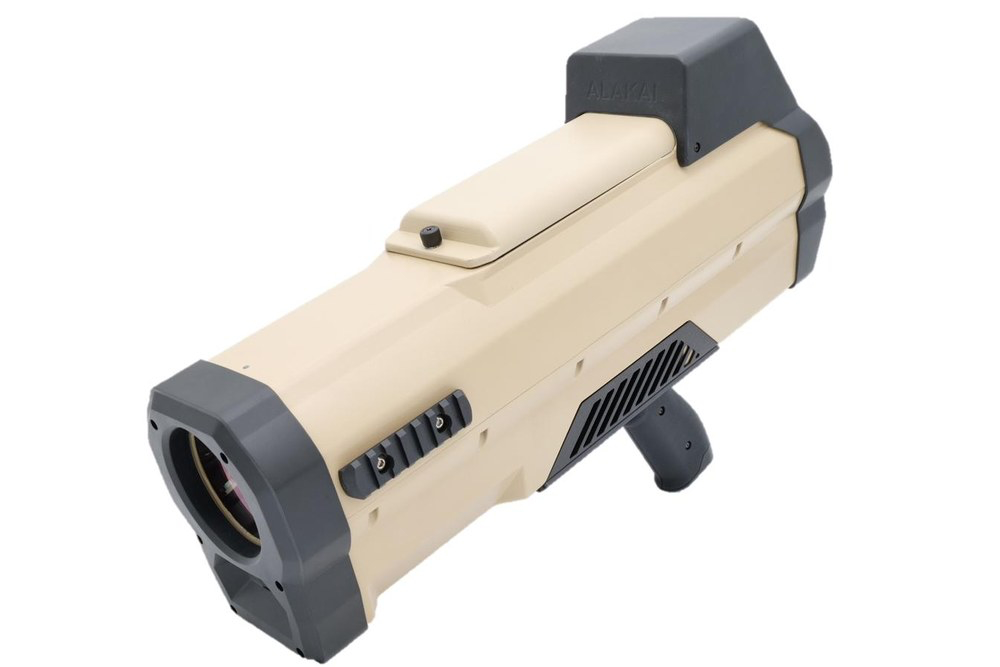
Argos handheld deep UV Raman standoff chemical detector
Core C-IED / EOD Capabilities
- Standoff identification: 0.7 to 15 meters from the target.
- Fast results: 4 to 15 seconds typical integration time per shot.
- Explosives and HME library: Including explosives, HME, CWAs, TICs/TIMs and hazardous materials, identified by an on-board AI/machine-learning trained algorithm.
- Trace to bulk: Detects bulk samples, residues and trace samples.
- Works in daylight: The 261 nm laser operates outdoors in direct sunlight, conditions that can interfere with traditional infrared Raman systems.
- Evidence and reporting: A photograph is captured with every shot, and one-page PDF reports can be exported for documentation and forensic exploitation.
- Hot-zone ready: Designed for typical hot-zone tasks in Level A PPE, with remote operation from the cold zone via the included mobile device.
- Rugged: MIL-STD-810H shock and vibration tested.
Global Footprint & Operational Support
- Export classification: Argos is not ITAR-controlled; it is classified under ECCN 1A004.D. Licensing requirements depend on destination and end user.
- Local support: International customers are supported through Alakai’s local channel partners, with reachback support from Alakai.
- Continuous improvement: Standard software updates are released twice a year, and Alakai works with customers to expand the chemical library with region-specific data.
See Argos in Action
-
- Trace explosive residue detection (3 trace explosives identified at 5 meters away in 20 seconds)
-
- Liquid trace detection (3 liquid trace samples representing explosives, CWAs, and TICs at 5 meters away in 20 seconds)
-
- Speed of analysis in bright daylight (10 samples in bright daylight in 2 minutes)
About Alakai Defense Systems, Inc.
Alakai Defense Systems is a veteran-owned technology company based in the Tampa Bay region of Florida within the United States. For more than 20 years, Alakai has specialized in deep ultraviolet (UV) laser and electro-optical sensors for standoff detection of chemical threats in defense and security applications. Alakai designs and manufactures its systems in-house in Florida.
Visit alakaidefense.com or contact us at [email protected] | Tel: +1 727 541 1600
Sign up for the Counter-IED Report Newsletters
The latest news and insights delivered right to your inbox
Related:
- DHS S&T Funds Solution to Increase Efficiency of Air Cargo Screening
March 5, 2019
Air Cargo skids and pallets take up a large amount of space on every commercial passenger flight. Federal law requires this cargo be screened at the same level as checked baggage. Single and dual energy X-ray systems can be scaled up to screen air cargo skids, but they produce two-dimensional views of air cargo that ...
- Brussels Airport failed to spot bomb belt security test
February 28, 2019
“On 1 October last year, I was asked to try to pass the security checkpoint with a fake bomb belt”, said the mystery passenger, HLN reports. “The belt looked very credible, with wires, a detonator and a substance that had the same density as real explosives,” added the passenger. When being searched, the passenger pretended to be a ...
- IATA Warns Of Aviation Security Risks, Calls For Better Collaboration With Governments
February 27, 2019
At the IATA Aviation Security Conference (AVSEC World) in Miami, FL, IATA Director General and CEO, Alexandre de Juniac called on governments to work with the aviation industry to ensure greater coordination in aviation security initiatives and warned against a lack of communication on critical security matters, as was the case during the 2017 ban on ...
- Paper strip that detects explosives could shake up airport security, Edmonton researcher says
February 22, 2019
Christina Gonzalez can detect explosives with a single strip of paper. Gonzalez, an Edmonton-based researcher, has developed a disposable test strip capable of instantly detecting explosive materials including traces of TNT, the compound used in dynamite. While the paper strip may look like plain card stock there is more than meets the eye. “Essentially, we have a stock ...
- Radar to spot the bad guys from on high
February 15, 2019
China’s space engineers said they can now offer a new method to detect terrorists transporting explosives as well as track moving targets more efficiently than current modalities. Researchers at the Beijing Institute of Radio Measurement, affiliated with the China Aerospace Science and Industry Corp, said they have developed the country’s first terahertz radiation-enabled synthetic-aperture radar and ...
- The European Commission has adopted new measures to improve aviation security in the European Union
January 28, 2019
On 23 January 2019, the European Commission adopted an Implementing Regulation amending Implementing Regulation (EU) 2015/1998 as regards clarification, harmonisation and simplification as well as strengthening of certain specific aviation security measures. The amendments concern measures in the areas of airport security, the revision of the rules on background check in order to enhance security culture and resilience, ...
- Britain to provide Libya with explosive detection equipment
January 23, 2019
Britain has signed a memorandum of understanding (MoU) on Wednesday to provide explosive detection equipment to Libya’s Mitiga International Airport. British ambassador to Libya Frank Baker, and the Head of the Libyan Airports Department, Mohamed Bait al-Mal, signed the MoU, said a statement issued by the Libyan airports authority. “The signed MoU aims to establish joint cooperation ...
- DHS SBIR Solicitation for FY19
January 4, 2019
The Department of Homeland Security (DHS) Small Business Innovation Research (SBIR) Program, comprised of the Science and Technology (S&T) Directorate’s SBIR Program and the Countering Weapons of Mass Destruction (CWMD) Office SBIR Program, invites small business concerns to review this pre-solicitation notice, which is intended to lead to the FY19 DHS SBIR Phase I solicitation. Read ...
- HEMRL develops device to detect 25 types of explosives
December 15, 2018
A group of scientists from High Energy Materials Research Laboratory (HEMRL) of Defence Research and Development Organisation (DRDO) has developed a device called ‘OPX Revilator’, which can detect more than 25 pure explosives as well as trace of explosives mixtures in mud, sand, sugar, salt and diesel oil. “An explosive detection kit, known as EDK, was ...
- Duke University researchers work toward an artificial nose to replace K9 dogs
December 3, 2018
Walk into airport security lines in the United States, and you’ll see K9 dogs sniffing for anything from narcotics to explosives. But what if a robot could do the same thing? Duke researchers recently published a paper in which they used mouse genes to grow odor receptors that could respond to specific odors. If this could ...
- 10 Problems DHS Wants Innovative Small Businesses to Solve in 2019
December 3, 2018
The department will be offering millions of dollars to small businesses able to offer solutions to these 10 tough technical problems. The Homeland Security Department released a list of 10 bleeding-edge research areas it plans to pursue in fiscal 2019 in partnership with innovative small businesses. The department’s Science and Technology Directorate and Countering Weapons of Mass ...
- A ‘robo-nose’ that could replace sniffer dogs is being built by scientists to detect narcotics, explosives and missing people
November 20, 2018
Trusty sniffer dogs that are used to detect drugs, explosives and missing people could soon be replaced by a ‘robo-nose’. Trained dogs are taught to use their sensitive sense of smell to detect the presence of certain chemicals and scientists have successfully recreated a robotic alternative. Researchers used genes from the nose of mice to develop the ...
- Route clearance unit gets new components for its life-saving mine detection vehicles
November 15, 2018
U.S. Army Reserve Soldiers from the 305th Engineer Company (Clearance) are tasked with travelling supply routes looking for deadly improvised explosive devices (IED), and other explosive threats. The 305th recently received updated components for their Husky Mounted Detection Systems (HMDS). The new components allow the soldiers to better see explosive threats buried in the ground. The ...
- New NATO scientific projects to help with the fight against terrorism
November 12, 2018
Three technologies on detection and clearance of improvised explosive devices (IEDs), namely a semi-autonomous robot for detection of mines and IEDs, a lightweight and easy-to-use mine detector and a handheld detector for dirty bombs, were successfully tested in Florence, Italy on 17 and 18 October 2018. These technologies are developed in the framework of NATO’s ...
- India: 39 airports to get hand-held explosives scanner
November 9, 2018
Small airports will soon get an additional layer of security, with the Airports Authority of India (AAI) procuring real-time viewing systems for 39 airports, including Bhopal, Dehradun, Trichy and Jodhpur, two officials familiar with the matter said. The equipment is essential for the functioning of bomb detection and disposal systems and used for the detection of ...