
 PRESS RELEASE • FOR IMMEDIATE RELEASE
Argos identifies explosives, homemade explosives and other chemical threats without contact at up to 15 meters with results in seconds.
TAMPA BAY, Florida, USA — October 16, 2026— Alakai Defense Systems, Inc., a veteran-owned technology company based in the Tampa Bay region of Florida, is introducing Argos, its handheld deep ultraviolet (UV) Raman standoff chemical detector, to explosive ordnance disposal (EOD), bomb technicians, counter-IED and security teams worldwide.
Argos identifies explosives, homemade explosives (HME), explosive precursor chemicals, chemical warfare agents (CWA), toxic industrial chemicals (TICs), toxic industrial materials (TIMs), and other chemical threats/hazardous materials without contact, at standoff distances of up to 15 meters, with results between 4 and 15 seconds. Operation is simple – the operator aims Argos, fires and receives a color-coded result – red for a threat, green for a non-threat – with supporting full chemical identification information, hazard data from the GHS database, photographic evidence of what was analyzed, GPS coordinates, and the spectrum of the material.
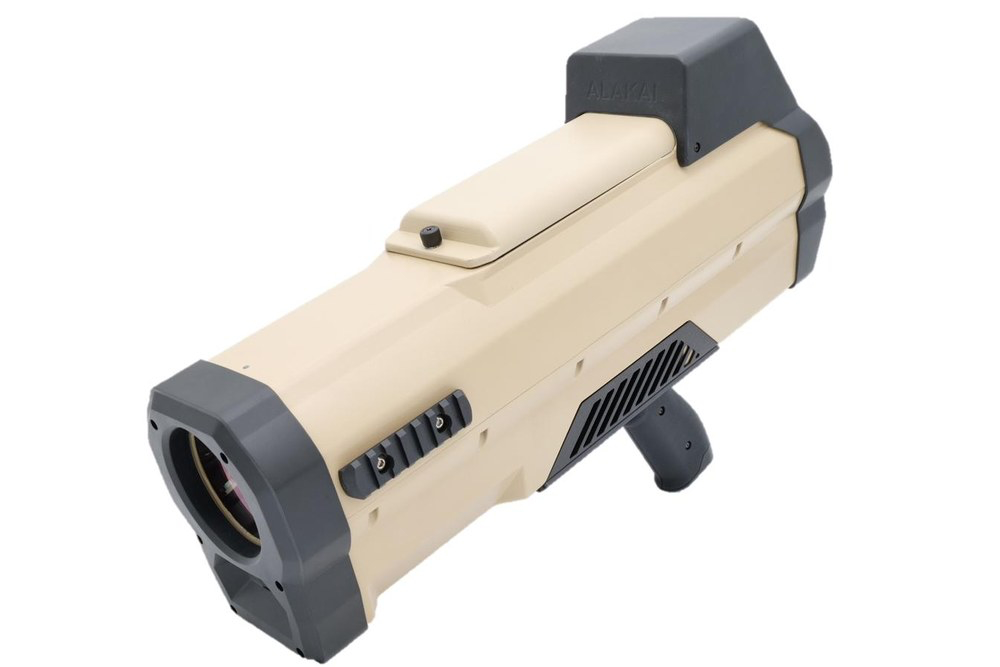
Argos handheld deep UV Raman standoff chemical detector
Core C-IED / EOD Capabilities
- Standoff identification: 0.7 to 15 meters from the target.
- Fast results: 4 to 15 seconds typical integration time per shot.
- Explosives and HME library: Including explosives, HME, CWAs, TICs/TIMs and hazardous materials, identified by an on-board AI/machine-learning trained algorithm.
- Trace to bulk: Detects bulk samples, residues and trace samples.
- Works in daylight: The 261 nm laser operates outdoors in direct sunlight, conditions that can interfere with traditional infrared Raman systems.
- Evidence and reporting: A photograph is captured with every shot, and one-page PDF reports can be exported for documentation and forensic exploitation.
- Hot-zone ready: Designed for typical hot-zone tasks in Level A PPE, with remote operation from the cold zone via the included mobile device.
- Rugged: MIL-STD-810H shock and vibration tested.
Global Footprint & Operational Support
- Export classification: Argos is not ITAR-controlled; it is classified under ECCN 1A004.D. Licensing requirements depend on destination and end user.
- Local support: International customers are supported through Alakai’s local channel partners, with reachback support from Alakai.
- Continuous improvement: Standard software updates are released twice a year, and Alakai works with customers to expand the chemical library with region-specific data.
See Argos in Action
-
- Trace explosive residue detection (3 trace explosives identified at 5 meters away in 20 seconds)
-
- Liquid trace detection (3 liquid trace samples representing explosives, CWAs, and TICs at 5 meters away in 20 seconds)
-
- Speed of analysis in bright daylight (10 samples in bright daylight in 2 minutes)
About Alakai Defense Systems, Inc.
Alakai Defense Systems is a veteran-owned technology company based in the Tampa Bay region of Florida within the United States. For more than 20 years, Alakai has specialized in deep ultraviolet (UV) laser and electro-optical sensors for standoff detection of chemical threats in defense and security applications. Alakai designs and manufactures its systems in-house in Florida.
Visit alakaidefense.com or contact us at [email protected] | Tel: +1 727 541 1600
Sign up for the Counter-IED Report Newsletters
The latest news and insights delivered right to your inbox
Related:
- India reiterates commitment to increased defence collaboration with Nigeria
January 25, 2020
The Indian Government has reiterated its commitment to further enhance the existing defence collaboration with Nigeria towards expanding the capabilities of both countries. The Acting Director of Defence Information, Brig.-Gen. Onyema Nwachukwu, disclosed this in a statement on Friday in Abuja. Nwachukwu said the Indian High Commissioner to Nigeria, Amb. Abhay Thakur gave the commitment when he ...
- US Takes Back 10 ‘Antiterrorism Assistance’ Dogs From Morocco
December 24, 2019
The US Department of State has taken back 10 “antiterrorism assistance” dogs from Morocco, announced the US Office of the Inspector General (OIG). “In August 2019, 10 canines were repossessed from Morocco because the dogs were not being used for their intended purpose,” says a report declassified this month. Morocco has received a number of dogs ...
- The US has decided to stop sending bomb-sniffing dogs to two Middle Eastern countries after many of the animals died
December 21, 2019
The US has made the decision to temporarily stop sending explosive-detection dogs to Jordan and Egypt after discovering that a lot of the animals had died as a result of poor treatment, a report from the Department of State’s Office of the Inspector General revealed. The department watchdog, which had previously pushed the Department of State to ...
- Indian Army gives 10 bomb-sniffing dogs to Bangladesh
December 10, 2019
Twenty more MDDs will be gifted to Bangladesh Army in two batches in April 2020 and October 2020 Indian Army has gifted 10 Mine Detection Dogs (MDDs) to Bangladesh Army as a goodwill gesture. The dogs were handed over at a ceremonial function at Petrapole-Benapole ICP recently, according to Indian High Commission in Dhaka. Twenty more MDDs will ...
- ACI launches new guidance on Computed Tomography technology screening
December 3, 2019
Airports Council International (ACI) World has today launched a new implementation guide for Computed Tomography – or CT – screening technology that can help airports improve efficiency and passenger experience at security checkpoints. The Advanced Cabin Baggage Screening / Computed Tomography (CT) Implementation Guide was developed with ACI’s Smart Security Management Group, which is comprised of some of ...
- “Innovation Checkpoint” and “digital dog nose”: TSA tests new security technology
November 25, 2019
The Transportation Security Administration is bracing for a record number of people at airport security checkpoints around the country this Thanksgiving. Nearly 27 million passengers are expected to be screened during the holiday period, meaning travelers could face long security lines. But new technology being tested by the TSA could speed up screenings and address passenger complaints ...
- Nigerian DRDB and Indian DRDO sign MoU to produce IED detectors
November 23, 2019
The Defence Research and Development Bureau (DRDB) yesterday signed a Memorandum of Understanding (MoU), with the Defence Research and Development Organization (DRDO), India, to produce the Ramon Improvised Explosive Device (IED) materials detector with standoff at distance. With the agreement, the DRDB is free to make use of the DRDO’s photonics laboratory in India to produce the ...
- Discover the spray used by Belgian police to train specialist dogs at airports
October 28, 2019
The explosive TATP has been used in several deadly terrorist attacks over the past two decades, which is why it is important that police are able to detect it. But the substance is extremely dangerous to handle, making it difficult to train police dogs or to test detector devices in crowded places like airports. That’s why European ...
- Why explosives detectors still can’t beat a dog’s nose
October 24, 2019
As of 2016, the US military counted over 1,740 military working dogs among its ranks. At Lackland Air Force Base in San Antonio, the military breeds its own sleek puppies—mainly German shepherds and Belgian Malinois—who are groomed for military service from their first whimper. Some will wash out; others will go on to four to ...
- Nigeria: EOD may deploy new detection systems to airport, seaport
October 22, 2019
Two new mobile radiation detection equipment donated to the Explosives Ordinance Disposal (EOD) by the United State (US) may be deployed to the airport and seaport to check threats to nuclear security, the police said yesterday. Police Commissioner in charge of EOD Maikudi Shehu disclosed this in Lagos while taking delivering of the equipment donated by ...
- The Duke and Duchess of Cambridge see how Melton military dog trainers teach Pakistani army handlers
October 21, 2019
Their Royal Highnesses, The Duke and Duchess of Cambridge, have seen first-hand how training delivered at Melton’s Defence Animal Training Regiment (DATR) is being replicated over 5,000 miles away in Pakistan. The visit of Prince William and Kate to the new Pakistan Army Canine Centre in Islamabad – part of a four-day royal tour – gave ...
- Schonstedt Magnetic Locators Support Somalia Demining Efforts
October 16, 2019
In collaboration with the United Nations Mine Action Service (UNMAS), four Magnetic Locators from Schonstedt Instrument Company have deployed to Somalia, approximately 6 miles north of the nation’s capital, Mogadishu, to locate explosive remnants of war (ERW). About the Site The Daynile district, located in the Banaadir region of Somalia, encompasses the northern outskirts of the nation’s ...
- A helping paw: Michigan Air National Guard partnership provides venue for multinational K9 law enforcement training
October 3, 2019
“Good boy, Ryker, good boy.” Jed Avery, a deputy with the Osceola County Sherriff’s Department, Reed City, Michigan, tussles the Dutch shepherd’s neck, offering a bite at his favorite chew toy. Only seconds ago, the canine had lit into action, dashing from asphalt to the rear seat of an SUV, where he met an officer in padded ...
- Desi Mudhol hunting hounds to help Indian Army sniff out IEDs, aid counterinsurgency ops
September 28, 2019
Three years after the Army inducted the indigenous breed of Mudhol hounds in its inventory, the canines have now been validated at several units for operations and other routine duties, top sources have told ThePrint. The training of these Karnataka-origin hunting hounds first started in 2016 by the Army’s Remount and Veterinary Corps (RVC) centre in ...
- DHS Scientist Develops Chemical-Based Contraband Detection Method
September 20, 2019
A chemist from the Department of Homeland Security’s Transportation Security Laboratory has created an approach to detect contraband from luggage and clothing. Jim Deline, a scientist from TSL, has built a device that can gather traces of contamination through the use of a special swab, DHS said Thursday. Additionally, screening officers can analyze and validate the presence of ...