
 PRESS RELEASE • FOR IMMEDIATE RELEASE
Argos identifies explosives, homemade explosives and other chemical threats without contact at up to 15 meters with results in seconds.
TAMPA BAY, Florida, USA — October 16, 2026— Alakai Defense Systems, Inc., a veteran-owned technology company based in the Tampa Bay region of Florida, is introducing Argos, its handheld deep ultraviolet (UV) Raman standoff chemical detector, to explosive ordnance disposal (EOD), bomb technicians, counter-IED and security teams worldwide.
Argos identifies explosives, homemade explosives (HME), explosive precursor chemicals, chemical warfare agents (CWA), toxic industrial chemicals (TICs), toxic industrial materials (TIMs), and other chemical threats/hazardous materials without contact, at standoff distances of up to 15 meters, with results between 4 and 15 seconds. Operation is simple – the operator aims Argos, fires and receives a color-coded result – red for a threat, green for a non-threat – with supporting full chemical identification information, hazard data from the GHS database, photographic evidence of what was analyzed, GPS coordinates, and the spectrum of the material.
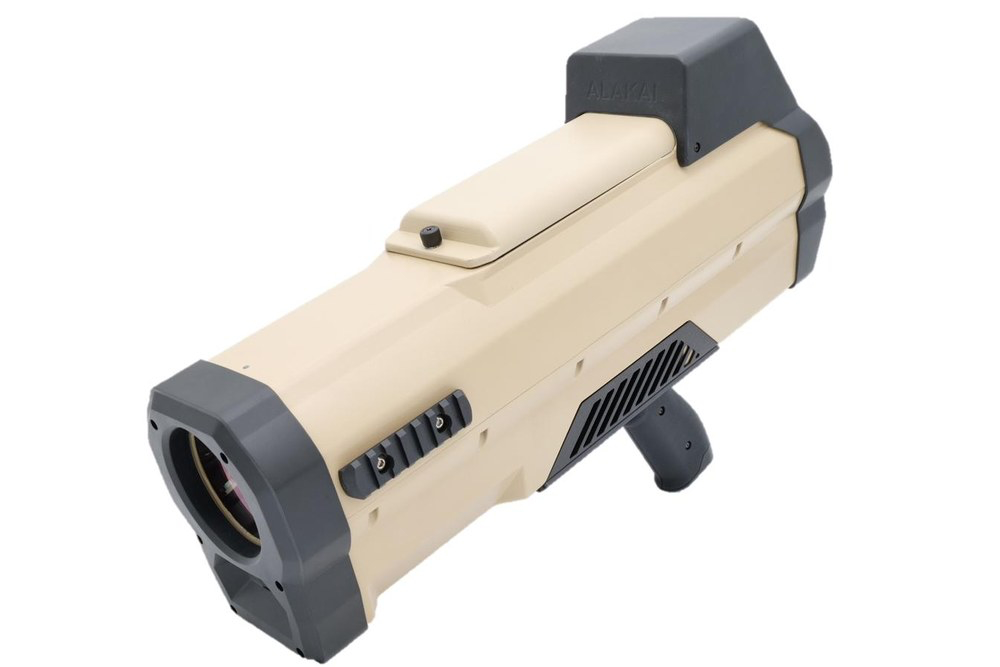
Argos handheld deep UV Raman standoff chemical detector
Core C-IED / EOD Capabilities
- Standoff identification: 7 to 15 meters from the target.
- Fast results: 4 to 15 seconds typical integration time per shot.
- Explosives and HME library: Including explosives, HME, CWAs, TICs/TIMs and hazardous materials, identified by an on-board AI/machine-learning trained algorithm.
- Trace to bulk: Detects bulk samples, residues and trace samples.
- Works in daylight: The 261 nm laser operates outdoors in direct sunlight, conditions that can interfere with traditional infrared Raman systems.
- Evidence and reporting: A photograph is captured with every shot, and one-page PDF reports can be exported for documentation and forensic exploitation.
- Hot-zone ready: Designed for typical hot-zone tasks in Level A PPE, with remote operation from the cold zone via the included mobile device.
- Rugged: MIL-STD-810H shock and vibration tested.
Global Footprint & Operational Support
- Export classification: Argos is not ITAR-controlled; it is classified under ECCN 1A004.D. Licensing requirements depend on destination and end user.
- Local support: International customers are supported through Alakai’s local channel partners, with reachback support from Alakai.
- Continuous improvement: Standard software updates are released twice a year, and Alakai works with customers to expand the chemical library with region-specific data.
See Argos in Action
-
- Trace explosive residue detection (3 trace explosives identified at 5 meters away in 20 seconds)
-
- Liquid trace detection (3 liquid trace samples representing explosives, CWAs, and TICs at 5 meters away in 20 seconds)
-
- Speed of analysis in bright daylight (10 samples in bright daylight in 2 minutes)
About Alakai Defense Systems, Inc.
Alakai Defense Systems is a veteran-owned technology company based in the Tampa Bay region of Florida within the United States. For more than 20 years, Alakai has specialized in deep ultraviolet (UV) laser and electro-optical sensors for standoff detection of chemical threats in defense and security applications. Alakai designs and manufactures its systems in-house in Florida.
Visit alakaidefense.com or contact us at [email protected] | Tel: +1 727 541 1600
Sign up for the Counter-IED Report Newsletters
The latest news and insights delivered right to your inbox
Related:
- DHS S&T Awards $6.8 Million for Five R&D Projects to Improve X-Ray Detection Technology
November 13, 2017
The Department of Homeland Security (DHS) Science and Technology Directorate (S&T) has awarded funding to four research and development (R&D) projects that will improve the threat detection capabilities of current X-ray technologies for passenger X-ray baggage systems. These projects will be managed by the DHS S&T Checked Baggage Program, part of the Homeland Security Advanced Research Projects Agency Explosives Division ...
- Fluorescent polymer detects traces of explosive devices
September 8, 2017
Bomb plots could be thwarted with the help of a portable system for detecting traces of high explosives using fluorescent polymer nanoparticles, developed by A*STAR. Coated on to paper, these polymers display an explosive-detection performance far more robust than previous materials with similar properties. Many methods have been developed to detect traces of high explosives such ...
- AI computer chips made of mice neurons that can SMELL explosives could transform airport security
August 28, 2017
A technology expert has created a computer chip based on mice neurons that could recognise the smell of explosives. The device could be implanted into the brain of future robots, which could be trained to recognise danger via odours, replacing traditional airport security. The Koniku Kore device is a ‘world first’ that is able to breath in ...
- Laser Ablation-Vacuum Capture System Can Identify Trace Substances in Fingerprints
August 4, 2017
Using IR laser ablation coupled with vacuum capture, a system of fingermark sampling has been developed that could be used for traditional fingerprint analysis and also to capture, filter and analyze biomolecules and trace substances such as DNA or explosives. Laser ablation at three micrometer (µm) was performed in reflection mode with subsequent capture of the ...
- Training of bomb-sniffing dogs could improve with new mass spectrometry tool
July 20, 2017
Law enforcement has long relied on canines to sniff out dangerous explosives, but large discrepancies exist between individual dogs’ performances that are at least partially attributable to training differences. Now, analytical chemistry may help give the dogs’ powerful sense of smell a keener edge. Researchers have developed a device that could improve dogs’ training by ...
- Pakistan Army receives cutting edge explosives detection equipment from US
July 19, 2017
ISLAMABAD: The Pakistan Army received more than 50 new Fido X3 explosives detectors from the US Embassy’s Office of the Defense Representative-Pakistan (ODRP). The Fido is a sophisticated hand-held device that will allow Pakistani soldiers determine in less than ten seconds whether an item is composed of explosives. These newest Fidos will be added to those ...
- Major security breach in Uttar Pradesh, explosive found in assembly
July 15, 2017
In a major breach of security in the highest echelons of governance, unidentified persons managed to smuggle in one of the deadliest plastic explosives, PETN, inside the Uttar Pradesh assembly, thumbing the nose at the precinct’s three-tier security system. Police sources said Pentaerythritol Tetranite (PETN) in crystalline form, weighing around 150gm, was possibly sneaked inside the House ...
- Agilent Technologies Acquires Raman Spectroscopy Innovator, Cobalt Light Systems
July 7, 2017
Cobalt’s portfolio of solutions accelerates entry into high-growth Raman spectroscopy market and expands Agilent’s value proposition for pharmaceutical and biopharma customers. Agilent Technologies Inc. (NYSE: A) today announced it has acquired Oxfordshire, U.K.-based Cobalt Light Systems, a provider of highly differentiated Raman spectroscopic instruments for the pharmaceutical industry, applied markets, and public safety. Cobalt’s innovative suite of ...
- Nanobionic spinach plants can detect explosives
October 31, 2016
After sensing dangerous chemicals, the carbon-nanotube-enhanced plants send an alert. Spinach is no longer just a superfood: By embedding leaves with carbon nanotubes, MIT engineers have transformed spinach plants into sensors that can detect explosives and wirelessly relay that information to a handheld device similar to a smartphone. This is one of the first demonstrations of engineering ...
- Can next-generation bomb ‘sniffing’ technology outdo dogs on explosives detection?
July 7, 2016
With each terrorist attack on another airport, train station or other public space, the urgency to find new ways to detect bombs before they’re detonated ratchets up.Chemical detection of explosives is a cornerstone of aviation security. Typically called “trace detection,” this approach can find minuscule amounts of residue left behind after someone handles an explosive. A ...