
 PRESS RELEASE • FOR IMMEDIATE RELEASE
Argos identifies explosives, homemade explosives and other chemical threats without contact at up to 15 meters with results in seconds.
TAMPA BAY, Florida, USA — October 16, 2026— Alakai Defense Systems, Inc., a veteran-owned technology company based in the Tampa Bay region of Florida, is introducing Argos, its handheld deep ultraviolet (UV) Raman standoff chemical detector, to explosive ordnance disposal (EOD), bomb technicians, counter-IED and security teams worldwide.
Argos identifies explosives, homemade explosives (HME), explosive precursor chemicals, chemical warfare agents (CWA), toxic industrial chemicals (TICs), toxic industrial materials (TIMs), and other chemical threats/hazardous materials without contact, at standoff distances of up to 15 meters, with results between 4 and 15 seconds. Operation is simple – the operator aims Argos, fires and receives a color-coded result – red for a threat, green for a non-threat – with supporting full chemical identification information, hazard data from the GHS database, photographic evidence of what was analyzed, GPS coordinates, and the spectrum of the material.
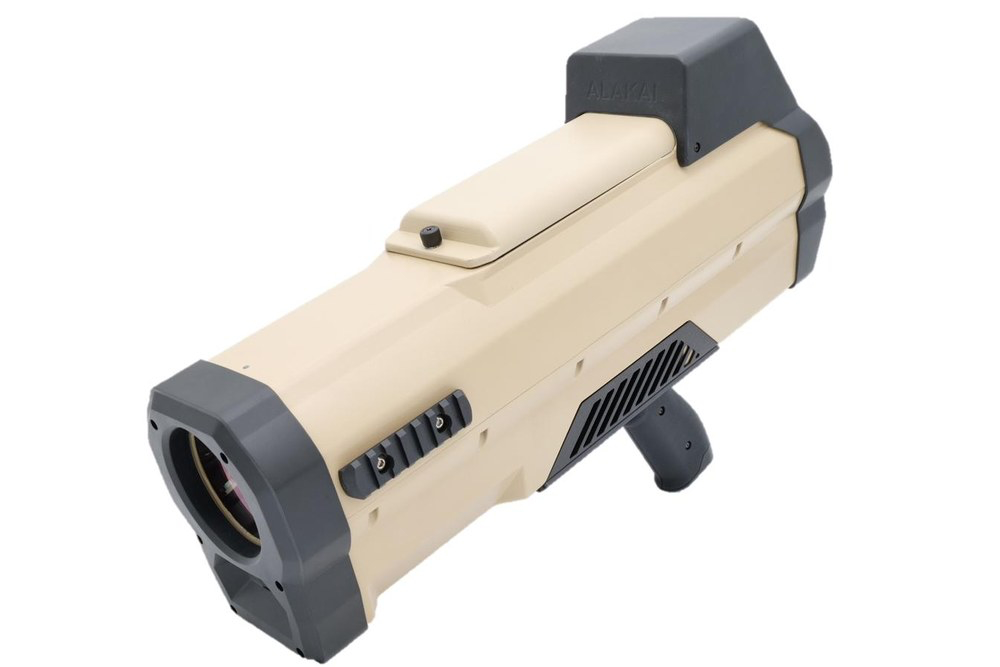
Argos handheld deep UV Raman standoff chemical detector
Core C-IED / EOD Capabilities
- Standoff identification: 0.7 to 15 meters from the target.
- Fast results: 4 to 15 seconds typical integration time per shot.
- Explosives and HME library: Including explosives, HME, CWAs, TICs/TIMs and hazardous materials, identified by an on-board AI/machine-learning trained algorithm.
- Trace to bulk: Detects bulk samples, residues and trace samples.
- Works in daylight: The 261 nm laser operates outdoors in direct sunlight, conditions that can interfere with traditional infrared Raman systems.
- Evidence and reporting: A photograph is captured with every shot, and one-page PDF reports can be exported for documentation and forensic exploitation.
- Hot-zone ready: Designed for typical hot-zone tasks in Level A PPE, with remote operation from the cold zone via the included mobile device.
- Rugged: MIL-STD-810H shock and vibration tested.
Global Footprint & Operational Support
- Export classification: Argos is not ITAR-controlled; it is classified under ECCN 1A004.D. Licensing requirements depend on destination and end user.
- Local support: International customers are supported through Alakai’s local channel partners, with reachback support from Alakai.
- Continuous improvement: Standard software updates are released twice a year, and Alakai works with customers to expand the chemical library with region-specific data.
See Argos in Action
-
- Trace explosive residue detection (3 trace explosives identified at 5 meters away in 20 seconds)
-
- Liquid trace detection (3 liquid trace samples representing explosives, CWAs, and TICs at 5 meters away in 20 seconds)
-
- Speed of analysis in bright daylight (10 samples in bright daylight in 2 minutes)
About Alakai Defense Systems, Inc.
Alakai Defense Systems is a veteran-owned technology company based in the Tampa Bay region of Florida within the United States. For more than 20 years, Alakai has specialized in deep ultraviolet (UV) laser and electro-optical sensors for standoff detection of chemical threats in defense and security applications. Alakai designs and manufactures its systems in-house in Florida.
Visit alakaidefense.com or contact us at [email protected] | Tel: +1 727 541 1600
Sign up for the Counter-IED Report Newsletters
The latest news and insights delivered right to your inbox
Related:
- Excelsior Challenge prepares first responders for emergency situations
September 18, 2019
More than 100 first responders came together Wednesday for the 2019 Excelsior Challenge. The training took place at the Department of Homeland Security’s State Preparedness Training Center at 5900 Airport Rd. in Oriskany. Bomb squads, explosive detection canine teams and tactical teams from around the state received hands-on training to help increase coordination amongst each other. The ...
- TSA moving forward with airport screening system deployment
September 11, 2019
Several senators voiced concern over the Transportation Security Administration’s slow rollout of new airport screening technology at a hearing Wednesday. Commerce Committee members Sens. Roger Wicker, R-Miss., and Shelley Moore Capito, R-W.Va., questioned acting Deputy Administrator Patricia Cogswell about the delay in meeting the TSA Modernization Act requirement. TSA lost about 90 days because a contract for 300 computed tomography ...
- Meet this year’s top military working dog
August 27, 2019
A Marine had been injured by an IED, an improvised explosive device, so the pair were looking for other bombs in the area. Suddenly, Tarwoe stepped on a buried IED, and it exploded, killing him. Yeager suffered shrapnel wounds that took months to recover from and cost him part of his right ear. Ninety-two military working dogs died in ...
- Liquid restrictions to end at UK airports thanks to new technology
August 25, 2019
Air passengers will no longer have to take liquids and laptops out of their carry-on bags under new rules coming into force for UK airports to upgrade their security scanners. Similar to CT scanners used in hospitals, the new technology will provide a detailed picture of a bag’s contents and allow images to be visually rotated ...
- Australia: Fake improvised explosive devices slip through regional airport security
August 1, 2019
Serious security deficiencies have been uncovered at Townsville Airport, with fake bombs passing through screening undetected. In April this year aviation inspectors, with Home Affairs, conducted what is known as red teaming tests. Two fake improvised explosive devices passed through without being spotted by staff. Last month another device slipped through without anyone noticing. Terrorism expert Neil Fergus ...
- DHS S&T Labs Demo Portable Explosive Trace Detectors
July 19, 2019
Two laboratories under the Department of Homeland Security’s science and technology directorate are teaming up to test portable explosives trace detectors. Researchers from the Transportation Security Laboratory validated gaps with the detectors and have spoken with vendors and customers to reinforce the devices’ functionality, DHS said Thursday. In a separate demonstration, a team from the National Urban ...
- Heathrow scanners mean liquids can stay in bags
June 6, 2019
Passengers at Heathrow airport will be able to keep their liquids and laptops inside their carry-on bags, once new security equipment is installed. The airport is investing £50m in the computer tomography (CT) security scanners, to be rolled out over the next few years. The technology, similar to CT scanners used in hospitals, provides a clear picture ...
- Body scanners to replace metal detectors at airport
May 13, 2019
Airport operator, GVK, has called for an expression of interest for the supply of body scanners for installation at Chhatrapati Shivaji Maharaj International Airport. These scanners will replace the existing door frame metal detectors and hand-held scanners, besides pat-down searches of the passengers to detect metallic objects. “Use of body scanners will save time. Passengers will ...
- How We’ll Stop Chemical Attacks
April 28, 2019
DARPA has been testing equipment that can detect chemical ingredients in weapons and explosives—before they’re used against us. And it’s almost ready to go. The scene isn’t all that hard to imagine. It’s Memorial Day. The Indianapolis 500, the world’s largest sporting event, is underway. At least four-hundred thousand fans are standing, stomping and screaming. Far ...
- £2.5m injection for drone swarms
April 3, 2019
The ‘Many Drones Make Light Work’ project is the largest single contract awarded by DASA to date. The funding will steer the project for around 20 unmanned aerial systems (UAS) into the final stage of development, which will ultimately be managed by the Defence Science and Technology Laboratory (Dstl). UAS are currently in widespread use around ...
- DHS S&T Seeks Partners for First Responder Technology R&D
April 2, 2019
The Department of Homeland Security (DHS) Science and Technology Directorate (S&T) invites industry, academia, laboratories, and the innovation community to submit white papers related to 12 first responder technology funding opportunities. The new Broad Agency Announcement (BAA) solicitation (BAA 18-02 Call 0001) will remain open until May 1st, 2019. “We want to help first responders of all disciplines do their ...
- Hero dogs receive bravery awards: Canine OBEs for dogs who helped at scenes of terror attacks
April 2, 2019
A police mutt probably wouldn’t know what to do with a medal, unless you covered it in gravy or made it look like a tasty chihuahua. He or she is much more likely to appreciate an extra few biscuits for dinner – and would probably love you forever. That is probably what seven dogs from the Met ...
- Pulwama aftermath: CRPF to enhance counter-IED capabilities, procure new fleet of MPVs troops in Kashmir Valley
March 26, 2019
The CRPF will procure a new fleet of mine protected vehicles (MPVs) and small 30-seater buses to ensure safety of its troop’s convoys in the Kashmir Valley, the chief of the force has said. The paramilitary has also decided to enhance the number of its bomb detection and disposal squads (BDDS) for its 65 battalions based ...
- Defense Department awards $1.4M to VCU professor to study process leading to explosions
March 21, 2019
The Department of Defense has awarded two grants totaling nearly $1.4 million to a Virginia Commonwealth University chemistry professor to study the initial steps of decomposition in “energetic molecules” that leads to explosions. Katharine Moore Tibbetts, Ph.D., an assistant professor in the Department of Chemistry in the College of Humanities and Sciences, received a five-year, $1 million Army Research ...
- Las Vegas airport to test machines to detect explosives
March 11, 2019
As Las Vegas’ airport continues to see record-breaking passenger traffic, keeping those travelers safe is a top priority. McCarran International Airport is set to test four explosive detection machines at the Terminal 3 security checkpoint, county Director of Aviation Rosemary Vassiliadis said last month during her presentation to the Assembly Committee on Infrastructure and Growth. The project, ...