
 PRESS RELEASE • FOR IMMEDIATE RELEASE
Argos identifies explosives, homemade explosives and other chemical threats without contact at up to 15 meters with results in seconds.
TAMPA BAY, Florida, USA — October 16, 2026— Alakai Defense Systems, Inc., a veteran-owned technology company based in the Tampa Bay region of Florida, is introducing Argos, its handheld deep ultraviolet (UV) Raman standoff chemical detector, to explosive ordnance disposal (EOD), bomb technicians, counter-IED and security teams worldwide.
Argos identifies explosives, homemade explosives (HME), explosive precursor chemicals, chemical warfare agents (CWA), toxic industrial chemicals (TICs), toxic industrial materials (TIMs), and other chemical threats/hazardous materials without contact, at standoff distances of up to 15 meters, with results between 4 and 15 seconds. Operation is simple – the operator aims Argos, fires and receives a color-coded result – red for a threat, green for a non-threat – with supporting full chemical identification information, hazard data from the GHS database, photographic evidence of what was analyzed, GPS coordinates, and the spectrum of the material.
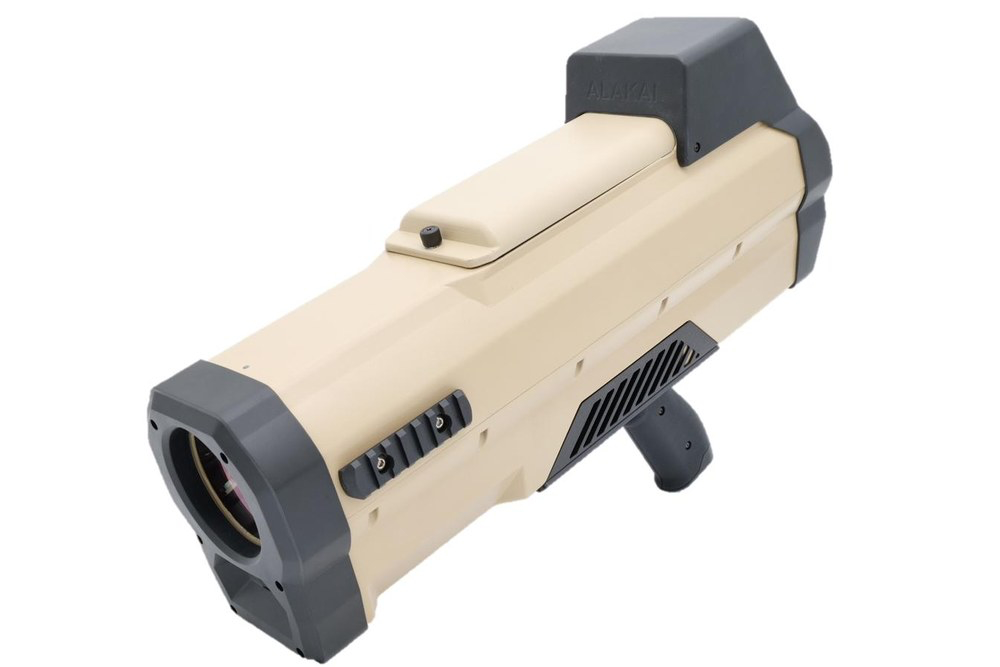
Argos handheld deep UV Raman standoff chemical detector
Core C-IED / EOD Capabilities
- Standoff identification: 7 to 15 meters from the target.
- Fast results: 4 to 15 seconds typical integration time per shot.
- Explosives and HME library: Including explosives, HME, CWAs, TICs/TIMs and hazardous materials, identified by an on-board AI/machine-learning trained algorithm.
- Trace to bulk: Detects bulk samples, residues and trace samples.
- Works in daylight: The 261 nm laser operates outdoors in direct sunlight, conditions that can interfere with traditional infrared Raman systems.
- Evidence and reporting: A photograph is captured with every shot, and one-page PDF reports can be exported for documentation and forensic exploitation.
- Hot-zone ready: Designed for typical hot-zone tasks in Level A PPE, with remote operation from the cold zone via the included mobile device.
- Rugged: MIL-STD-810H shock and vibration tested.
Global Footprint & Operational Support
- Export classification: Argos is not ITAR-controlled; it is classified under ECCN 1A004.D. Licensing requirements depend on destination and end user.
- Local support: International customers are supported through Alakai’s local channel partners, with reachback support from Alakai.
- Continuous improvement: Standard software updates are released twice a year, and Alakai works with customers to expand the chemical library with region-specific data.
See Argos in Action
-
- Trace explosive residue detection (3 trace explosives identified at 5 meters away in 20 seconds)
-
- Liquid trace detection (3 liquid trace samples representing explosives, CWAs, and TICs at 5 meters away in 20 seconds)
-
- Speed of analysis in bright daylight (10 samples in bright daylight in 2 minutes)
About Alakai Defense Systems, Inc.
Alakai Defense Systems is a veteran-owned technology company based in the Tampa Bay region of Florida within the United States. For more than 20 years, Alakai has specialized in deep ultraviolet (UV) laser and electro-optical sensors for standoff detection of chemical threats in defense and security applications. Alakai designs and manufactures its systems in-house in Florida.
Visit alakaidefense.com or contact us at [email protected] | Tel: +1 727 541 1600
Sign up for the Counter-IED Report Newsletters
The latest news and insights delivered right to your inbox
Related:
- TSA allows third parties to certify sniffer dogs for air cargo screening
November 8, 2018
Private companies and individuals with sniffer dog teams will soon be able to screen air cargo in the US after the TSA approved 12 organisations to assess third-party explosives detection canine teams. Starting from November 1, 3PK9-C Certifiers will be able to start the process to certify sniffer dog teams. Under the new programme, third-party canine ...
- Outcry as a quarter of all hero military dogs are put down for being ‘unfit for service’
October 21, 2018
Dozens of military dogs were put down last year after they were found to be unfit for service. A total of 41 were euthanised when they could no longer perform the demanding roles they were trained for. The dogs were found to have illnesses and chronic conditions while others were healthy and judged to be unsuitable for ...
- Thai businessman convicted of selling fake bomb detectors
September 28, 2018
A court in Thailand has convicted a local businessman of fraud for selling fake bomb detectors to the Thai government, five years after the head of the British supplier was sent to prison over the global scandal. Thailand’s military drew criticism and ridicule in 2010 when the GT200 bomb detectors — which were claimed to also ...
- UK To Donate £5 Million Of Military Equipment To Jordan
September 13, 2018
The UK is set to donate more than £5 million of military equipment to Jordan in a bid to strengthen the kingdom’s borders. The move, signed off by the Foreign Office, will see unarmoured vehicles, observation devices, radios, detectors to find improvised explosive devices, medical packs and uniforms sent to the Jordanian Armed Forces. Foreign Secretary Jeremy Hunt, ...
- Scientists propose a new method for detecting dangerous nitrogen-containing liquids
September 11, 2018
A team of researchers from the Institute of Physical and Mathematical Sciences and Information Technologies of Immanuel Kant Baltic Federal University (BFU), together with their colleagues from Gebze Technical University, used nuclear magnetic resonance to detect toxic and flammable nitrogen-containing liquids. The study was published in Chemical Physics. Nuclear magnetic resonance (NMR) is the effect of energy ...
- Finding explosives in electrical items demonstration day
August 13, 2018
The Defence and Security Accelerator (DASA) and the Future of Aviation Security Solutions (FASS) team will be hosting a demonstration day to showcase the innovations that we have accelerated through the first phase of our ‘Finding Explosives Hidden in Electrical Items’ competition. This is an exciting opportunity to learn more about these innovations direct from the developers. The event will give ...
- New York Port Authority Bus Terminal To Test New Security System on Monday
August 11, 2018
Commuters into the Port Authority Bus terminal on Monday will be part of a pilot to test a new security system, one that will try and identify suicide vests and other improvised explosive devices. The Port Authority will launch the pilot test next week on the new security system designed to help law enforcement professionals. The technology, in partnership ...
- Heathrow scanner trial could ease airport liquid ban
July 23, 2018
The machines take a 3D X-ray, allowing security staff to check items without requiring them to be removed from bags, and can detect explosives. The worldwide rules began in 2006 after a terror plot was stopped by UK police. The Department for Transport said a “small number” of trials was set to last between six and 12 ...
- Powders to be banned from hand luggage at UK airports
July 9, 2018
Powders such as make-up, coffee and spices are to be banned from hand luggage on flights leaving the UK in a new effort to improve airport security. The move, which raises the prospect of more queues and disruption for travellers, would follow in the footsteps of Australia, New Zealand and the US, where passengers were told last ...
- New Competition: ‘Airport Vehicle Checkpoint Screening’
June 29, 2018
The Defence and Security Accelerator (DASA) is launching a new competition on behalf of the Future Aviation Security Solutions programme (FASS) focusing on vehicle checkpoint (VCP) screening at airports. This competition is focusing on new solutions to the challenge of vehicle checkpoint (VCP) screening at airports, in order to prevent explosives, weapons and other threats from ...
- New NATO project to help with real-time detection of explosives in public transport
June 15, 2018
A new NATO project, EXTRAS, led by research institutions in Italy and Serbia, will make it possible to detect explosives and prevent terrorist attacks on public transport. The project, funded by NATO’s Science for Peace and Security (SPS) Programme, will use laser spectroscopy to identify explosive materials on potential bombers. The project started on 14 June ...
- Trained bees make first warzone discovery of lost explosives confirms Scots scientist
June 15, 2018
Trained bees have been successfully used for the first time to find mines in a former Yugoslavian warzone, a Scottish scientist has revealed. The honey bees led mine clearance teams to unexploded ordnance in Croatia after they were trained to hone in on the smell of explosives. Dr Ross Gillanders of St Andrews University helped design equipment ...
- Towards Cheap, Miniaturized, Robust Sensors For Explosives
April 9, 2018
The compound 2,4,6-Trinitrotoluene (TNT) is an explosive material widely used for military, industrial, and mining applications. Its reduction products are known to be toxic and carcinogenic to humans and may contaminate and accumulate in soils and drinking water. Furthermore, being one of the most commonly-used industrial explosives, the procurement of TNT by terrorists to build improvised ...
- Libya steps up security measures against terror attacks in Benghazi
February 12, 2018
Libya’s eastern-based government said Sunday that it adopted a package of security measures to counter terrorist threats in the eastern city of Benghazi. The interim government said in a statement that the cabinet and security leaders of Benghazi had tightened security measures to prevent terrorist threats in the city after an emergency meeting held with Prime ...
- Using technology to detect hidden threats
February 9, 2018
Soldiers in combat have to constantly scan their surroundings for improvised explosive devices (IEDs), a signature weapon of modern warfare. These homemade bombs are often hidden—nestled in bushes, buried underground, or sometimes stuffed inside other objects. Now, a research group at the University of Delaware is developing technology to detect explosive devices from a distance. Chandra ...