
 PRESS RELEASE • FOR IMMEDIATE RELEASE
Argos identifies explosives, homemade explosives and other chemical threats without contact at up to 15 meters with results in seconds.
TAMPA BAY, Florida, USA — October 16, 2026— Alakai Defense Systems, Inc., a veteran-owned technology company based in the Tampa Bay region of Florida, is introducing Argos, its handheld deep ultraviolet (UV) Raman standoff chemical detector, to explosive ordnance disposal (EOD), bomb technicians, counter-IED and security teams worldwide.
Argos identifies explosives, homemade explosives (HME), explosive precursor chemicals, chemical warfare agents (CWA), toxic industrial chemicals (TICs), toxic industrial materials (TIMs), and other chemical threats/hazardous materials without contact, at standoff distances of up to 15 meters, with results between 4 and 15 seconds. Operation is simple – the operator aims Argos, fires and receives a color-coded result – red for a threat, green for a non-threat – with supporting full chemical identification information, hazard data from the GHS database, photographic evidence of what was analyzed, GPS coordinates, and the spectrum of the material.
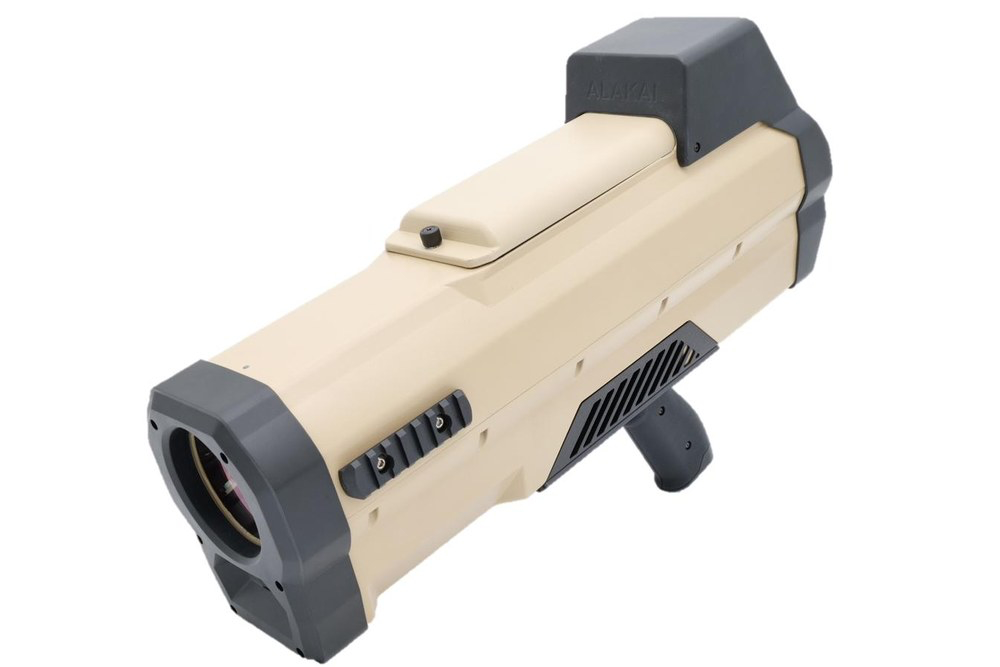
Argos handheld deep UV Raman standoff chemical detector
Core C-IED / EOD Capabilities
- Standoff identification: 0.7 to 15 meters from the target.
- Fast results: 4 to 15 seconds typical integration time per shot.
- Explosives and HME library: Including explosives, HME, CWAs, TICs/TIMs and hazardous materials, identified by an on-board AI/machine-learning trained algorithm.
- Trace to bulk: Detects bulk samples, residues and trace samples.
- Works in daylight: The 261 nm laser operates outdoors in direct sunlight, conditions that can interfere with traditional infrared Raman systems.
- Evidence and reporting: A photograph is captured with every shot, and one-page PDF reports can be exported for documentation and forensic exploitation.
- Hot-zone ready: Designed for typical hot-zone tasks in Level A PPE, with remote operation from the cold zone via the included mobile device.
- Rugged: MIL-STD-810H shock and vibration tested.
Global Footprint & Operational Support
- Export classification: Argos is not ITAR-controlled; it is classified under ECCN 1A004.D. Licensing requirements depend on destination and end user.
- Local support: International customers are supported through Alakai’s local channel partners, with reachback support from Alakai.
- Continuous improvement: Standard software updates are released twice a year, and Alakai works with customers to expand the chemical library with region-specific data.
See Argos in Action
-
- Trace explosive residue detection (3 trace explosives identified at 5 meters away in 20 seconds)
-
- Liquid trace detection (3 liquid trace samples representing explosives, CWAs, and TICs at 5 meters away in 20 seconds)
-
- Speed of analysis in bright daylight (10 samples in bright daylight in 2 minutes)
About Alakai Defense Systems, Inc.
Alakai Defense Systems is a veteran-owned technology company based in the Tampa Bay region of Florida within the United States. For more than 20 years, Alakai has specialized in deep ultraviolet (UV) laser and electro-optical sensors for standoff detection of chemical threats in defense and security applications. Alakai designs and manufactures its systems in-house in Florida.
Visit alakaidefense.com or contact us at [email protected] | Tel: +1 727 541 1600
Sign up for the Counter-IED Report Newsletters
The latest news and insights delivered right to your inbox
Related:
- Airport security experts to approach industry for new baggage screening technologies to speed passengers
May 27, 2020
Goal is a net false alarm rate of less than 10 percent with advanced technologies that can pinpoint home-made explosives in checked passenger baggage. Washington: – U.S. aviation security experts are asking industry to come up with improved ways of screening airport passenger baggage for a wide variety of home-made explosives with reduced false-alarm rates, and an ability to ...
- Liberia: World Customs Organisation donates precursor chemicals and explosives testing kits to Revenue Authority
May 27, 2020
The Customs Department of the Liberia Revenue Authority (LRA) has received a donation of testing kits for precursor chemicals and explosives from the World Customs Organization (WCO). The LRA says the equipment will be used by Customs to uncover smuggling of narcotic drugs, dangerous chemicals and other harmful substances into the country. The donation, valued at ...
- Security experts worry about hand sanitizers on aircraft
May 24, 2020
Back in 1987, a liquor bottle filled with explosives and placed in a carry-on bag in an overhead bin helped terrorists crash a South Korean airliner. All 115 on board died. Then, in 1994, Al-Qaeda member Ramzi Yousef, architect of the first World Trade Center bombing, detonated liquid nitroglycerin that he had taken on board a ...
- Wagtail UK launches explosive detection dog services for air cargo
May 20, 2020
Wagtail UK has achieved government certification to provide explosive detection dog services for the UK air cargo industry. The company said that it had undertaken a “rigorous training programme” set out by the UK government to prepare its Free Running Explosive Detection Dogs (FREDD) for air cargo screening. Wagtail’s first dog to successfully achieve government certification, Ben, ...
- Nigeria: Goverment deploys explosive detectors in 15 airports
May 8, 2020
The Nigerian Federal Government has deployed hi-tech explosive screening equipment at 15 of the 22 airports in the country, the local PUNCH newspaper reported Wednesday, quoting the spokesperson for the aviation parastatal, Mr. Yakubu Dati. Revealing this Tuesday, Dati said the remaining seven airports will get theirs shortly, according to the paper. Dati said that between July ...
- Could Airbus’s ‘E-Nose’ Put Bomb-Sniffing Dogs Out a Job?
May 6, 2020
If you’ve ever boarded an airplane for an international flight, you’ve likely come into direct contact with a very cute but very formidable bomb-sniffing dog. Once you’re on the airplane, though, the pooches aren’t typically along for the ride, meaning detection virtually ends at the security gate. To bridge the gap, aircraft manufacturer Airbus has partnered ...
- Purdue quantum research receives Department of Defense funding
May 4, 2020
Research into quantum techniques to more quickly detect explosives and exotic types of quantum camouflage have received funding from the U.S. Department of Defense’s 2020 Multidisciplinary University Research Initiative (MURI) program. The four faculty members who have been awarded projects in the competitive funding program are members of the Purdue Quantum Science and Engineering Institute in ...
- Iran’s ‘amazing’ Covid-19 detectors identified as re-purposed fake bomb scanners
April 16, 2020
Iran’s Islamic Revolutionary Guard Corps has unveiled what it claims is new technology which will change the face of its response to the coronavirus crisis. There’s just one problem – the “state of the art” Covid-19 detector bears a striking resemblance to fake bomb scanners that have plagued the Middle East and other parts of the ...
- How the National Guard dresses for COVID-19 and other disasters
April 6, 2020
We got a virtual tour of the gear on hand at a Weapons of Mass Destruction Civil Support Team. The coronavirus pandemic has understandably spurred millions to think about how they protect themselves—and others—in public spaces. And now, the Centers for Disease Control and Prevention is advocating for people to wear cloth masks to help stop anyone who ...
- Airport Council International (ACI) releases security screening best practices during COVID-19
March 20, 2020
As the COVID-19 global pandemic continues to unfold, Airports Council International (ACI) World has gathered the following best practices from airports and screening authorities to help protect screeners, passengers and staff while preserving aviation security objectives. Checkpoint management Prior to passengers or staff approaching screening points, hand sanitizers and disinfection products should be provided. If health screening ...
- UK: The Defence and Security Accelerator seeks novel technology to counter homemade bombs
March 9, 2020
The Defence and Security Accelerator is launching a competition to rapidly develop novel technology and techniques to boost the UK’s life-saving counter homemade bomb capability. Invisible Shield: Countering IEDs by novel technology and techniques seeks innovative proposals to thwart adversaries, terrorists and criminals from using everyday communications items such as radios or mobile phones and networks to ...
- RaIDer-X: DRDO unveils new explosive detection device
March 2, 2020
Defence Research and Development Organisation (DRDO) and IISC Bangalore recently unveiled a new explosive detection device. A new explosive detection device – RaIDer-X was recently showcased during the National Workshop on Explosive Detection (NWED-2020) on March 01, 2020. According to the reports, RaIDer-X can detect an explosive from a specific stand-off distance. It can also expand ...
- Cyborg grasshoppers have been engineered to sniff out explosives
February 17, 2020
Move over, sniffer dogs: now there are explosive-sensing grasshoppers. Barani Raman and his colleagues at Washington University in Missouri have tapped into the olfactory senses of the American grasshopper, Schistocerca americana, to create biological bomb sniffers. In insects, olfactory receptor neurons in their antennae detect chemical odours in the air. In turn, these neurons send electrical signals to a ...
- Melton military dog shortlisted for national award
February 13, 2020
A military dog based at Melton credited with saving the lives of ‘countless’ soldiers by detecting explosive devices during a long career serving in war zones has been shortlisted for a special national award. VROOM is one of three in contention for the Service Dogs accolade, one of four categories of the Autarky Hardest Working Dog ...
- Scientists develop portable sensors to trace explosives
February 10, 2020
Indian scientists have developed a cost-effective portable sensor that can trace explosives and toxic metals such as trinitrotoluene (TNT), trinitrophenol (TNP) and RDX even if just a few molecules are present, on the scale of parts per million (ppm). The senor, a solution, can be easily carried in public spaces like airports, railway and hotels ...