
By Wilder Alejandro Sanchez, international security analyst
The Republic of Colombia is experiencing a new wave of violence across the country which has resulted in a rising number of incidents involving anti- personnel mines, improvised explosive devices (IEDs) and unexploded ordnance (UXO), as narco-insurgent movements contaminate the countryside and rural areas with these weapons of war and terror.
Due to this internal security challenge, the Colombian government requested an extension to the State Parties to the Convention on the Prohibition of the Use, Stockpiling, Production and Transfer of Anti- Personnel Mines and on Their Destruction (henceforth the Ottawa Treaty) regarding the removal of mines, IEDs and UXO from its territory. The new deadline is 31 December 2025. However, even this deadline is perhaps too optimistic and ambitious, not because of problems with mine-clearing operations themselves, but because of rising violence.
THE NEW DEADLINE: 2025
In November, the 18th meeting of the State Parties to the Ottawa Treaty met in Geneva. It was during this meeting when the Colombian government presented its aforementioned request, which was unanimously agreed upon by the State Parties. The previous deadline was 31 March 2021.
A report about the meeting explains that “in granting the request, the Meeting noted that, while Colombia had largely complied with the commitments it had made in 2010, Colombia has an incomplete picture of the remaining challenges.” Moreover, “the Meeting noted the importance of Colombia identifying as soon as possible the precise perimeter of mined areas, to the extent possible, and establishing an updated evidence- based baseline of contamination in the remaining municipalities.” This request is somewhat problematic since, as we will discuss in subsequent sections of the commentary, the violence in the country continues and areas that were previously decontaminated could become contaminated once again as insurgent movements expand their areas of operations.
The report also noted that “Colombia provided implementation milestones for the period of 2020 – 2023 and Colombia’s intention to review its work plan in 2023, the Meeting noted that the Convention would benefit from Colombia submitting to the States Parties by 30 April 2023 an updated detailed work plan.” The statement suggests that April 2023 will be the next major deadline for Colombia’s new schedule, at which time the State Parties will get a better idea of how mine-clearing operations in Colombia are going. Since Colombia’s deadline to clear its territory is December 2025, the April 2023 report is a sort of halfway-point meeting to see if the new deadline is realistically possible.
The meeting of the State Parties to the Ottawa Treaty also mentioned how Bogota’s new strategy “is contingent upon stable funding, security, retaining strong partnerships with international stakeholders and other matters creating an environment conducive for implementation.” By “other matters” we can infer that this means the actual situation in the country, namely, ongoing operations to combat narco-guerrillas and other violent movements.
At this point, it is worth noting that the Colombian government has drafted the Humanitarian Demining Operational Plan 2020-2025 with this new deadline in mind. Apart from actually removing the mines and other explosives, the plan also stresses the importance of educating individuals that live in communities where mines are found so that they can identify these weapons. Moreover, the government stresses once again its commitment to helping victims of these weapons, and government agencies at all levels will continue to work together to “design, implement, monitor and evaluate” mine-removal operations throughout the country. While the latter part of the plan sounds self-evident, given the complexity of the problem, and since Colombia remains a conflict state, it is critically important to continuously monitor and adapt mine-removal strategies depending on the developments on the ground.
The strategic plan has several minor, more localized projects. For example, there is a plan aimed at mine-removal operations in 27 out of 56 natural parks (Sistema de Parques Nacionales Naturales de Colombia). Additionally the project also highlights the numerous international civilian agencies that are helping the Colombian military in mine-removal operations. These include the HALO Trust, Norwegian People’s Aid (Ayuda Popular Noruega), Humanity & Inclusion, and the Danish Demining Group.

2019 map of contaminated areas published by the Colombian government.
Source: GOV.CO – http://www.accioncontraminas.gov.co/descontaminacolombia/Paginas/Plan-Estrategico-2020-2025.aspx
DATA
According to data published by the Colombian government, a total of 7,557 artifacts (mines, IEDs, UXO) have been destroyed between 2004 and 31 October 2020. This number includes: 6,046 anti- personnel mines; 1,209 unexploded ordnance like munitions; and 302 IEDs.
Colombian military personnel and partner entities operate across the country, and data shows that different departments are at vastly different stages of decontamination. As we will discuss, renewed violence will change these numbers, but we will utilize the data provided by Bogota. For example, Antioquia department has a 32.45% percent of decontamination, Meta is at 11.21%, while Caldas is at 10.72%.
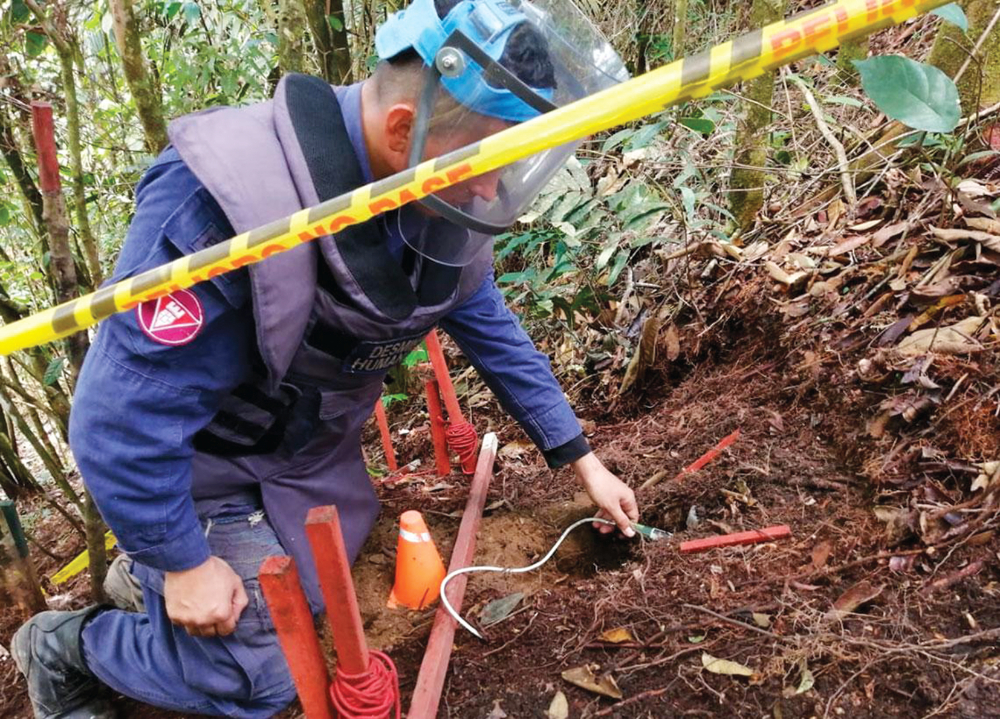
Military engineers find anti-personnel mines near a school and three homes in Caldas.
Source: The General Command of the Military Forces. https://www.cgfm.mil.co/es/blog/ingenieros-militares-hallan-minas-antipersonal-cerca-de-una-escuela- y-tres-viviendas-en-caldas
Meanwhile Putumayo department, which borders Ecuador and Peru, an area well known for cross-border smuggling, is at 2.66%; while Nariño, which borders Ecuador and the Pacific Ocean, borders at 2.30%.On the other side of the country, Arauca department, which borders the always problematic Venezuela, has been 0.03% cleared.
The Colombian government is optimistic about this new deadline as there have been several positive developments. On 9 December, the Colombian government reported that 432 municipalities are now free of mines. Specifically, 154 municipalities were decontaminated in the first two years of the Ivan Duque presidency. “This represents the fulfillment of 85% of the [administration’s] objective of having 180 territorial entities [decontaminated] by 2022,” the Colombian presidency explained in a 9 December press release.
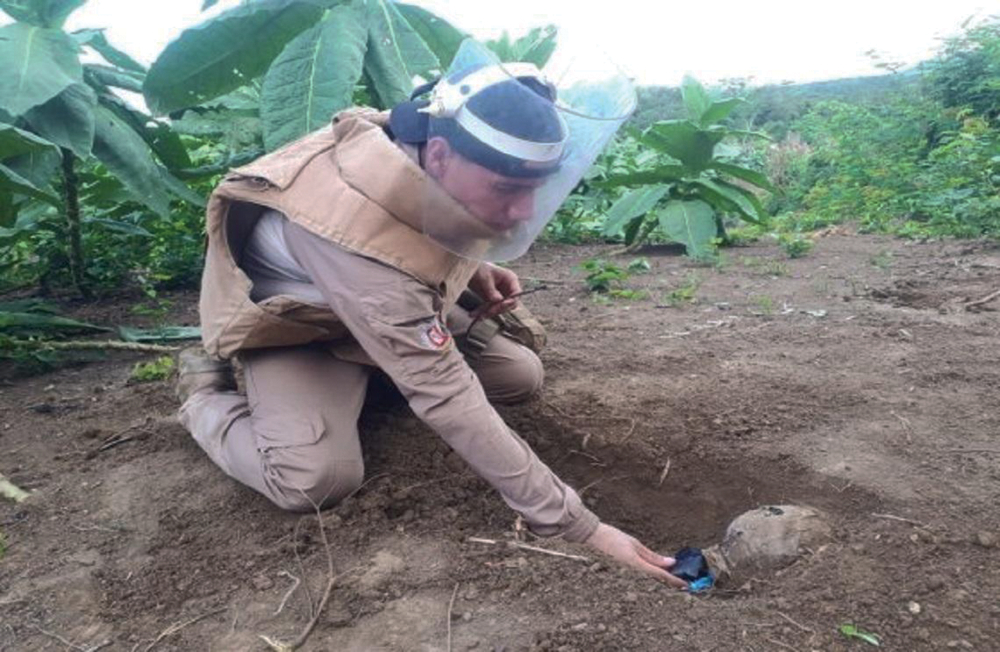
Colombian Navy destroys explosive devices in Bolívar in a controlled manner.
Source: The General Command of the Military Forces – https://www.cgfm.mil.co/es/blog/armada-de-colombia-destruye-de-manera-controlada-dos-artefactos-explosivos-en-bolivar
The newest municipalities are scattered across the country, including the departments of Bolivar (a hot spot for these weapons and violence in general), Cauca, Meta, Norte de Santander, Sucre, among others. The Colombian army announced that throughout 2020, its personnel cleared 17 municipalities free of mines.
The activities were particularly carried out by the military’s humanitarian demining brigade (Brigada de Desminado Humanitario: BRDEH), the marine infantry’s demining unit (Agrupación de Explosivos y Desminado de Infantería de Marina: AEDIM), and the Halo Trust, among other agencies. Over four thousand men and women are involved in these tasks.
INCIDENTS ON THE RISE
The aforementioned data can be better understood if we mention specific incidents involving the removal of these weapons of terror. For example, in late October, the Colombian navy neutralized one anti-personnel mine, which had two kg of explosives inside; and one 81 mm grenade, with 500 milligrams of explosives inside, in El Carmen de Bolivar, Bolivar department. The explosives were found by civilians, a peasant and an underage citizen respectively. The weapons were deactivated by personnel assigned to the humanitarian demining company No.1.
Weeks later, in late November, two anti-personnel mines were removed and neutralized, once again in Bolivar department. The mines were found by local villagers working the land, who subsequently contacted authorities. Personnel from the aforementioned humanitarian demining company No.1, assigned to the marine infantry brigade No. 1 were in charge of this operation. A press release from the Colombian navy mused that “it is believed [that the mines] were placed years ago due to the armed conflict in the region,” without attributing it to any particular insurgent group. Nevertheless, it is well known that in Bolivar the National Liberation Army (Ejercito de Liberacion Nacional: ELN) is operational – case in point, 17 members of the ELN’s “Luis Solano Sepúlveda” faction were arrested earlier this year, in said department. Hence it is likely that the aforementioned explosives were placed by this group.
Bolivar is a hot spot of mines and IEDs and the good news is that several areas have been declared free of mines and other explosives. For example, in early November, the Colombian navy, delivered three zones in the El Carmen de Bolivar and Zambrano municipalities, Bolivar department, to civilian authorities. A total of 4,778 square meters were searched by military personnel starting in late 2019, and one anti-personnel mine was found and neutralized.
Similarly, troops from the army’s mechanized battalion No. 18 and the special forces battalion for urban operations, were tasked with removing three explosive devices that were found “five metres away from a major road” in Arauca department. The explosives sound like IEDs as they contained 20 kg of pentolite, connected via wires that had a length of 200 m. On this occasion, the army has blamed the “Ernesto Che Guevara faction” of the ELN; authorities said that the ELN wanted to activate the bombs by a road that is utilized daily by military personnel and civilians.
Another incident took place in the Tibú municipality, Norte de Santander department, in early October, when army personnel assigned to the engineer battalion No. 50 deactivated an anti-personnel mine next to a pathway that connects two hamlets. Around the same time, an IED of undisclosed explosive power, was deactivated in another area.
Anti-personnel mines were also located by two schools in Fronterino, Antioquia department, according to a November 11 article in the Colombian news agency RCN Radio, however at the time of writing it is unclear if the Colombian military or other agencies have neutralized them.
The Colombian military has also been effective at neutralizing insurgents that actually install these weapons. For example, in late November, troops killed six insurgent members of a FARC faction (Grupo Armado Organizado residual E-18) in the northern part of Antioquia. Some of the neutralized insurgents were tasked with deploying IEDs in the area, the army explains.
SADLY, INJURIES AND FATALITIES CONTINUE
Unfortunately, not all mines, IEDs and UXO are successfully located and neutralized, since they continue to cause casualties and fatalities across the country. Case in point, a soldier died in Tarazá municipality, Antioquia department, after he stepped on a mine during an operation on 31 October. The Colombian military has accused the narco-movement Los Caparros that operates in the area, of having placed the mine. Months earlier, in July, a corporal and four soldiers were injured when an explosive was detonated during a patrol operation in Cauca department. Unfortunately, the corporal and one of the soldiers perished due to their wounds.
Moreover, civilians continue to be hurt or killed due to these weapons of terror. For example, in August, a man was killed when he stepped on an anti-personnel mine while he, his wife and child were walking by a river looking for food in Antioquia department. The other two members of the family were injured. The Colombian news outlet RCN has reported that four indigenous people have died in the area in recent years due to explosive devices. “This area of Antioquia department was under the control of the FARC, and now is disputed by residual factions [of FARC] and the Clan del Golfo,” explained a 9 August RCN article on the incident.
FINAL THOUGHTS
As expected, the State Parties to the Ottawa Treaty have approved Colombia’s request to extend the country’s deadline to remove explosives from its territory. However, the new deadline, 31 December 2025, may still be too optimistic. The main issue with Colombia’s plan is that the country is not a post-conflict state, as the ELN, FARC’s remaining factions and other narco- movements continue to operate throughout the country, and they rely on explosives to terrorize the civilians and attack military and police personnel.
The operations carried out by the Colombian military and its partner organizations are commendable, however it is difficult to believe that 2025 is achievable unless there are massive victories in the war against the country’s violent movements that occur parallel to mine-clearing operations. ■
ABOUT THE AUTHOR
 Wilder Alejandro Sanchez is an international security analyst who focuses on geopolitics, military and cyber security issues in the Western Hemisphere and post-Soviet states. He is a writer for Janes, Shephard Media, DefenceIQ, the Center for International Maritime Security,
among other publications. His analyses have appeared in numerous refereed journals including Small Wars and Insurgencies, Defence Studies, Polar Journal, the Journal of Slavic Military Studies, European Security, Studies in Conflict and Terrorism and Perspectivas. He has researched mine-clearing operations in other Latin American countries like Chile, Ecuador and Peru, as well as in the Republic of Moldova. Mr. Sanchez holds aMaster’sdegreeinInternationalPeaceandConflict Resolution from the School of International Service at American University, and he has attended the Institute of World Politics and the National Defense University’s William J. Perry Center in Washington DC.
Download PDF: 50-55 Wilder Alejandro Sanchez article – Proliferation of mines, IEDs and UXO in Colombia – Counter-IED Report Winter 2020-21