
By Ben Scarfe, a former Ammunition Technical Officer (ATO)
The increase in use of social media has impacted the majority of aspects of society, and the world of C-IED is no exception. There are even accounts which would best be described as ‘EOD Influencers’ who share content and support to the EOD community, including emerging threats in countries which are impacted by conflict. This information being freely available can be a double-edged sword. Whilst data collection has been a valuable resource in military and law enforcement, especially when tracking emerging risks and threats pertaining to the use of IEDs, there are risks that come from this information being readily accessible. In more extreme cases, a lack or breach of OPSEC could lead to an individual being targeted. This was a particularly acute threat during the days of Op HERRICK /TELIC, though this would often rely on spotters seeking to exploit supposed gaps in tactics, techniques and procedures (TTPs) of the troops on the ground. Today there are individuals and groups who are demonstrating these TTPs but instead using them as promotional material rather than considering the consequences of what exposing these drills could mean. The risk here is specific actions or render safe procedures could be studied and potentially targeted, should there be a wish to inflict harm on these individuals. No longer will there be a requirement for an adversary to painstakingly recce military organisations at risk to themselves. Instead, they can spend time on social media to identify areas to be exploited. Although today the majority of EOD Operations in conflict areas are being conducted by charities or NGOs, there may still be a wish to inflict harm on civilian EOD Operators to discourage such organisations operating within the country. There are recent notable examples of charity workers sadly being killed, or taken hostage or imprisoned, so there is a meaningful risk that charity workers could come to harm without the necessary due care and attention being placed on individuals and organisations.
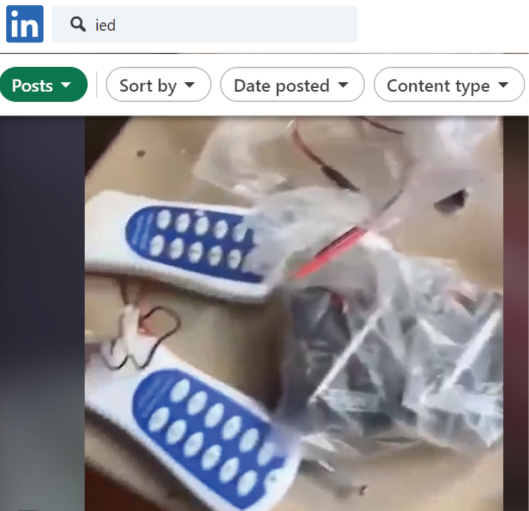
LinkedIn example of a RC transmitter/receiver.
Another consideration is when it comes to the use of Open-Source Intelligence (OSINT) when it comes to tracking activity globally. OSINT can again be a valuable tool to bolster the understanding of the types of explosive devices being employed as well as developments across various conflict zones across the world. However, the information is uncontrolled and can take time to verify. There are also always those bloaters or Walter Mitty types that will seek to elevate their experience or involvement, or even fabricate information entirely. Furthermore, there may be instances of multiple reporting of a single incident, which makes a threat seem more prominent than it actually is. Therefore, fact checking is always going to be required, as well as collating incident and exploitation reports, in order to corroborate and prove data. If these reports are freely posted online, it can be possible to identify whether attacks have been successful or to analyse failures based on the information being found on social media, which could in turn lead to a cycle of enhanced tactics and fault finding from bomb makers to improve the likelihood of success when using Improvised Explosive Devices. By outlining the successes of the EOD Operator, it can begin to shape terrorist TTPs as they look to target EOD Operators or law enforcement. In the cat and mouse game of C-IED, it is imperative that those responsible for IED use and emplacement are not given any additional support in the placement of devices.
Finally, one merely needs to trawl the appropriate areas of LinkedIn to find complex information pertaining to IED construction and booby trap techniques being used. Specifically, EOD Operators have been outlining detection equipment used by the EOD Operator and Search Teams, and also posting photographs of RC devices, IED diagrams and detailed schematics of booby traps. This is obviously the information that is of use to both sides of the threat picture. In order to counter this, I believe there should be a central body which can be responsible for providing individual risk assessments to EOD Organisations prior to them travelling to conflict zones. This should be easily accessible, but there should be a level of control of the access to the information, whether this be through an organisation such as UNMAS or another independent EOD risk assessment company. To support this, the following steps would be ideal for charities and NGOs to agree to prior to deploying personnel.
- Mandate that EOD organisations are required to report incidents into a central database which can then assist law enforcement and EOD specialists globally when conducting threat assessments.
- All humanitarian organisations set strict parameters for employees on what can and cannot be posted on social media.
- Any posts should be purely illustrative, without specific incidents being referenced.
- Companies should use authorised organisations to conduct area risk and threat assessments prior to deploying to areas with a known IED threat. This will allow the information to be correctly controlled and analysed before being distributed as fact.
Whilst there can be no mandating of sharing information in this more formal manner, I think that allocating a nominated body to control the data and to compile information would be of high value to organisations deploying to support areas around the world. ♦
ABOUT THE AUTHOR
Ben Scarfe is a former Ammunition Technical Officer (ATO) with 14 years’ experience with the British Army having served as a commissioned officer in the Royal Logistics Corps. He has served as an EOD Operator with 11 EOD & Search Regiment, before then moving to 2 Military Intelligence Battalion, which was responsible for Weapons Intelligence and Exploitation. On promotion to Major, he served with 29 EOD & Search Gp HQ overseeing global EOD & Search Operations, before finishing his career with Defence Equipment and Support as SO2 Army Light, Defence General Munitions. During his career, Ben deployed to Cyprus, Afghanistan and Pakistan, as well as providing support to UK EOD Operations. Ben is a chartered engineer with the Institute of Explosive Engineers, and now lives in France where he works for AXA as an Operations Specialist.
Download PDF: 38-39 Ben Scarfe article – Proliferation of IED and Booby Trap data on social media – COUNTER-IED REPORT, Winter 2024-25
COUNTER-IED REPORT, Winter 2024/25