
By Pierre Corman, Area Sales Manager, Teledyne ICM
When portable X-ray systems are compared, most attention goes to the detector. Resolution, pixel size and software features are easy to compare and to understand. The generator receives less attention. Yet it has a direct impact on image quality, ease of deployment and the amount of information that can be extracted from an image.
HAVING THE ABILITY TO ADAPT
No two suspicious items are the same.
A mobile phone, a battery pack and a steel container will not respond in the same way to X-rays. The ability to adjust the beam therefore matters.
With a constant potential generator, the operator can independently adjust voltage, current and exposure time. The beam can be adapted to the object rather than relying on a single fixed operating mode.
Lower kV settings are often useful when identifying wiring, switches, electronic circuits and other low- density materials. Higher kV settings improve penetration through thicker or denser objects.
This flexibility can also play a role when PIR sensors are a concern. Tests have shown that operating at lower kV can produce usable images while avoiding activation of most PIR sensors. Fixed high-voltage systems simply do not offer the same level of control.
In practical terms, adjustable kV gives the operator one more option when dealing with an unknown threat.
WHY FOCAL SPOT SIZE MATTERS
Focal spot size is often overlooked, yet it has a direct effect on image quality.
Every X-ray source creates a certain amount of geometric blur, and that blur increases as the focal spot becomes larger.
This effect is not always obvious when an object is placed directly on the detector, but real suspicious items rarely present such ideal geometry. Wires, switches and electronic components are often positioned several centimeters away from the detector, which naturally creates blur and magnification.
With a small focal spot, that magnification becomes an advantage: details appear larger while remaining sharp enough to interpret. With a larger focal spot, the same geometry increases blur and reduces the amount of useful information visible in the image.
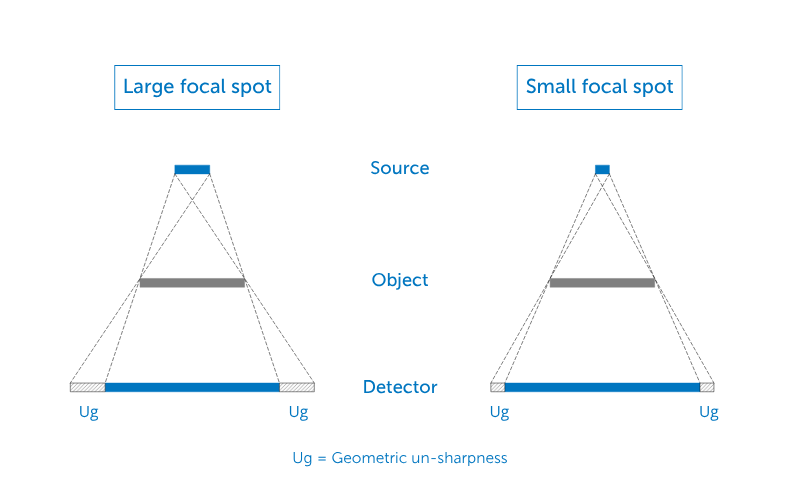
Figure 1: Effect of focal spot size on geometric unsharpness (Ug)
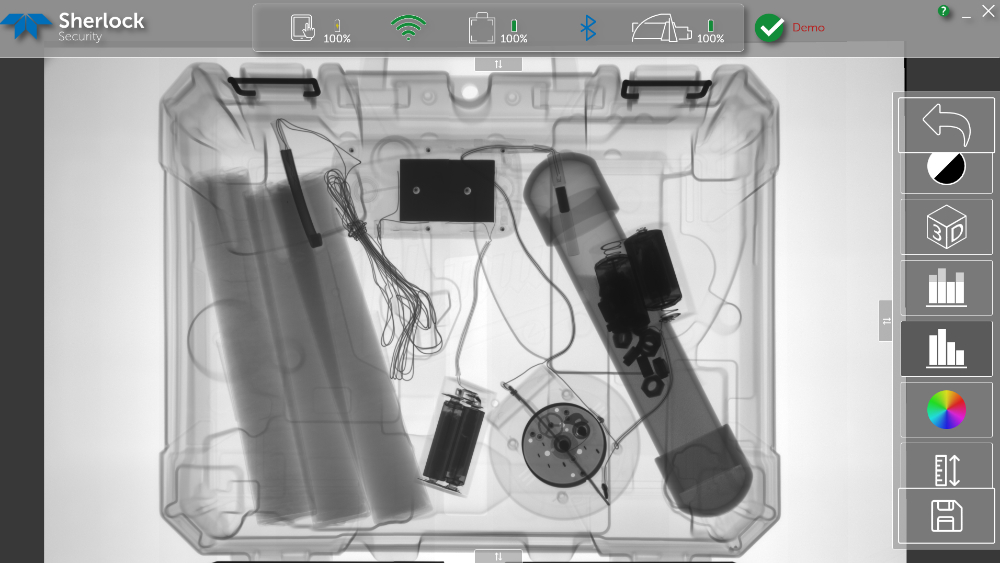
Figure 2: X-ray image acquired with a small focal spot generator, revealing fine internal details (displayed in Teledyne ICM Sherlock Security software)
Teledyne ICM’s CP120B and LiteX generators feature a focal spot of 0.8 x 0.5 mm, while the CP160B uses a focal spot of 0.8 x 0.7 mm. By comparison, many portable pulsed generators use significantly larger focal spots.
Smaller focal spots generally produce sharper edges, cleaner details and a clearer view of small hidden components.
DESIGNED FOR THE REAL WORLD
Field conditions are rarely ideal.
Generators need to fit around walls, vehicle seats, furniture, luggage and countless other obstacles. Ease of positioning therefore becomes more important than many people initially expect.
The CP120B and LiteX use a 50° x 50° beam and the CP160B a 60° x 60° beam. A wider beam can cover the detector from a shorter distance, making positioning easier in confined areas.
The side-emitting design of the CP120B and CP160B also changes the way the generator can be deployed. Because the beam exits from the side of the rotating tank rather than from the front of the unit, it is often possible to position the source in locations that would otherwise be difficult to reach.
THE DOSE DEBATE
Constant potential generators are sometimes perceived as producing more dose. The situation is not quite that simple. A constant potential generator emits radiation continuously during the exposure. Conventional dosimeters detect this radiation very easily.
From an operational point of view, this is often a secondary issue. During an inspection, nobody remains next to the suspicious item. The system is placed, the area is cleared, and the exposure is triggered remotely. Distance remains the primary protection measure, regardless of the technology being used.
RELIABILITY MATTERS TOO
Image quality is important, but durability is equally important.
A constant potential generator is designed for long operational life and intensive use without interruption for tube replacement. It ensures consistently stable output thanks to its regulated high-voltage supply.
CONCLUSION
A portable X-ray system is much more than a detector connected to a radiation source.
Focal spot size, beam geometry, flexibility and ease of positioning all influence the final image.
The objective is not simply to obtain an image. The real goal is to obtain information that supports a decision. The X-ray generator plays a major role in that process. ■
ABOUT THE AUTHOR
 Pierre Corman is responsible for market development across Europe and Southern Africa at Teledyne ICM. With over 20 years of experience in X-ray inspection technology, he works closely with customers and partners across a wide range of NDT and security applications.
Download PDF: 55-57 Pierre Corman Article – Image quality starts with the X-ray source – Teledyne ICM – Counter-IED Report Autumn 2026
Counter-IED Report, Autumn 2026